Have you ever had a feeling in your gut that you couldn't explain but was STRONG?
To this situation enter our word of the week: know.
Know a verb that means to perceive directly, to have direct cognition.
You know you'll get that job. You know this friend is meant to be a part of your inner circle, though you just met. You know your son or daughter is not in a lasting marriage. You know.
There's no way other to explain your confidence about a person or a situation than to say that you know.
I tell you this gut feeling of knowing is spiritual wisdom at it's finest. It's a gift of God. It's a helpful discernment tool if there ever was one for what to take on next and what to let go. It's a deposit of hope in your bank when hard times come (and they always do).
But knowing is a divine gift we so often ignore.
We say to ourselves, "Oh, how could I really?" Or "There's no way I should make plans in my life based on a feeling." Or, "What will people say if I do that?" It's so easy to make excuses or discredit our knowing.
But when we push knowing away, we miss out on God's leading in our lives.
A couple years ago I got a rejection letter for a workshop I applied to attend with the P.S. of "you're on the waiting list." I had applied to this opportunity with a great sense of knowing that this workshop was the thing I needed to do next to get a book project going. So, while it felt tempting to despair with the "we're sorry" email, I still knew it would work out (though of course my confidence didn't make much sense given my # on the waiting list). But, let me tell you, I kept my schedule clear just in case. And at the last minute someone dropped out and someone dropped out. There was a space for me at this amazing experience, and it was all that I hoped it would be!
I tell you this story not to say that your knowing always comes into fruition, but that sometimes it does. In due time. With patience. With an open mind.
Sometimes we have to wade through the waters of wait lists, rejection letters and unreturned phone calls for that moment -- that glorious moment when life falls into order and we can say: "I knew!"
Here's hoping you're able to trust your knowings this week. Know what you know what you know.
XO
Elizabeth
 What are you giving up for Lent this year?
How many times have you been asked that question already . . .
I really don't like it when folks ask me that. I'm sure it's because they assume I have something really holy to offer.
Yet I don't. I've never really fasted more than a couple of days. I am never one for long silent retreats (I just think I like talking too much). Or anything else you could name in the super holy category.
Since being serious about Lent in seminary, let me tell you my greatest hits of "giving up something for Lent":
In the past these practices have helped me remember that I am not my cravings. What gives me comfort and life and health is more about what I eat.
Nope. Not a thing.
Reading the gospel reading set for Ash Wednesday helped me arrive at this place: "Beware of practicing your piety before others in order to be seen by them." (Matthew 6:1).
These were Jesus' words from the Sermon on the Mount. They were a conversation changer when it came to how Jesus spoke to his disciples about actions and faith.
There's no reason to have piety for the sake of piety. If an action means nothing to you, just don't do it. Full stop.
Maybe this is why Jesus would later give instructions about fasting saying, "Whenever you fast, do not look dismal, like the hypocrites for they disfigure their faces to show others they are fasting."
Or a modern paraphrase would be "Don't go out to dinner with friends and make a big show of it when you're just ordering water."
Or, "Don't announce loudly at a dinner party that you've given up chocolate for Lent."
Or "Don't bully your partner into fasting if you are."
But hear me say, I don't think that Jesus is anti-fasting. There are certainly stories after stories of the spiritual practice of prayer and fasting throughout scripture. Fasting helps us rid ourselves of distractions. Fasting helps us align our daily life with spiritual rhythms of prayer. If you feel called to fast, fast I'd think Jesus would say do it.
But don't make a big fuss of it.
"Do not store up for yourselves treasures on earth, where moth and rust consume and where thieves break in and steal; but store up for yourselves treasures in heaven." (Matthew 6:19)
Because here's the point of Lent, really: 40 days of spiritual preparation for the season of Easter.
Lent helps get our shoes ready for Easter. The time when we get to shout and dance and sing Alleluia all we want. The time we get to celebrate the worst endings to stories never being the end. The time when hope is born again.
That's a lot to prepare for, wouldn't you say?
I'm going to stick to the spiritual journey I began at the beginning of the year during the season of Epiphany.
I'm going to remember the star word that has guided me so far in this new year: mystery.
I'm going to trust that even when my life seems OUT OF CONTROL, it's not.
Faith comes in when I believe the master Creator is orchestrating a beautiful plan I couldn't see coming, even if I tried to dream it up now. And practically what that means as far as daily discipline, I'm going to keep to myself (i.e. not making a big show of it). And do it.
What about you?
How can you find your way to what it means to live out Lent this year?
Here's three suggestions I have as you decide what to do/ not to do this season.
This could be in your car. It could mean getting up a little earlier or staying up a little bit past when your family goes to bed. Be still. And ask God to guide your desire for spiritual growth in this season. Often we're so busy that there is no stillness in our day to simply listen to the voice of the Spirit, what our calling is for now. Listen. And you'll have some clarity. You really will.
Talk through what frustrates you most about your daily routines. Ask for their wisdom about how they see you thriving or living in frustration. Often times, the clarity we need for spiritual practice is right in front of us, and all we have to do is ask and wisdom will appear.
Lent is a season of the year when churches of all flavors open up opportunities for spiritual growth that don't happen any other time of the year.
Is there a prayer group you can join? A class you can participate in?
A practice you could learn more about because it's what your pastor is leading you in worship? There's nothing better than engaging in a spiritual practice in community.
Maybe what you're looking for is already right around the corner from your house. You just have to go!
Wishing you a blessed Lenten journey in whatever way you decide to practice!
Know that as you discern what comes next for you in this holy season, God is with you.
And regardless of your piety or not, God looks at you and say, "You are my beloved child in whom I'm well-pleased."
 I am a cradle Christian.
My name was on the Sunday School roll in the church nursery before I was born.
The stories of scriptures and words of the Bible have always been readily accessible to me when I was just a toddler (as seen in this picture).
I could recite the books of the Bible by the time I was 7 and could name the fruits of the spirit from the book of Galatians by age 9. The Christian school my parents sent me to in junior high challenged me to read the Bible through in the 7th grade (and I did!). I had a working knowledge of church history high school. I really don't know another way, for good or the bad.
But, the older I get, I realize, my story is an anomaly.
We don't teach our kids Bible stories, Bible facts or even stories of faith like I was taught in the height of Southern Baptist evangelicalism of the 1990s. As stiff structure surrounding the institutional church dies, fewer and fewer kids are growing up as I did including my own daughter.
Instead, the folks that fill the church pews of the congregations I'm most drawn to pastor aren't people who would call themselves cradle Christians. Or if they do, they'd say they are "recovering from it." I also hear a lot of "I'm a Christian but not that kind . . . "
Maybe cradle Christians are a dying bred?
If this is true, then how then do people arrive at faith, then, if not by osmosis from childhood? Isn't that how most people chose a religious tradition?
Recently, while I attended Wild Goose Festival in Hot Spring, NC I had the opportunity to meet a fellow author with a story that answers such a question. Kate Rademacher is a recent convert to Christianity is the author of a new memoir called, Following the Red Bird: First Steps into a Life of Faith.
In her book, she describes how after years of living in a social conscious, yet secular home and marrying a practicing Buddhist husband, she finds herself hearing the voice of God for the first time.
Though her childhood idea of the Trinity was "reduce, reuse and recycle" she found herself saying "Hello" (literally just like that) to God. The conversation took off from there (how amazing!). Within months, Kate found herself on a Christian path learning more about Jesus then seeking baptism in the Episcopal Church several years later.
Kate's prose was refreshingly honest and engaging. You never feel like Kate is telling you what you want to hear but what actually is her experience of God. Once I started reading Following the Red bird, I couldn't put it down. I finished it the next day.
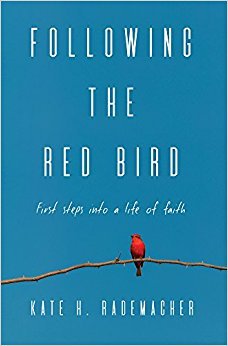 When I got to the last page, I felt grateful for the way that Kate calls out cradle Christians like me for our privilege (even if that was not the main focus of her story).
Seeing the world through Kate's lens, we, cradle Christians, have no idea how scary it is to walk into a study group with no working knowledge on the Bible.
We have no idea what it feels like to be drawn to a life of prayer without what to say.
We have no idea how discernment feels like without any spiritual tools to know if you're a helpful track or not.
So, as a pastor, I'm so thankful to have Kate's story as a resource for spiritual seekers who find their way to my inbox or office.
But even more than this, I'm grateful for how Following the Red Bird opened up my spiritual imagination.
We, as cradle Christians or even as professional ministers, can get so stressed out on God's behalf (or so we say).
We invest in lives, hoping for spiritual growth, but nothing changes. We preach our hearts out and it feels like no one is listening. We expect a particular trajectory for the spiritual formation of our children or grandchildren. And we feel sad when it doesn't happen.
I even saw that with the baptism of my daughter several months ago. Several well wishers remarked on social media that they wish she grows up to be a "God-fearing woman who takes to the teachings of the faith early." While I know it came from a loving place, my first reaction was "What pressure! Don't put that on her."
Here's the thing I believe about spiritual journeys (which Kate's story helped to me to see all over again): we can't control them.
The best conditions for spiritual instruction can't make a person find a personal conviction. Nor can lack of religious education keep a person from God when it's the right time for the journey to begin.
Openness is really the best gift we can give each other, especially to our children.
Isn't that what faith is about in the first place? Letting go and trusting in a power beyond what we can see?
I'm glad, as a cradle Christian, for the gift that Kate's faith story is to the world.
(Check out Kate's book on Amazon if you're looking for a faith memoir!)
 Want break up a conversation in a room? Say the word shame. Everyone stops talking.
I know this first hand from the experiences I've had this spring promoting Birthed: Finding Grace Through Infertility. One word has risen to define so many of the talks I've given is SHAME.
You can't speak about infertility without talking about shame couples feel when it shatters their dreams. One person voiced to me recently, "Infertility can make you feel like a second class citizen." So true! And while it's an uncontrollable medical condition, a infertile woman (and sometimes the man) believes it's her/ his fault! And so why would we talk about that? (Much less write a book about it!)
But by time I reached the publication date of Birthed, grace found me on the healing journey. As Nadia Bolz Webber is known to say, "it had become a scar, not a wound."
So now, as I'm on the road talking about Birthed, it has been baffling to me how many people have tried to shame me for telling my story.
Saying things like, "I can't believe you wrote that . . ."
Or, "I didn't know you were such a drunk . . ."
Or, "I would have stopped reading the book half way through if I didn't know you. You write too personally about things."
As easy as it would be to accept the shame others want me to feel about writing such a vulnerable memoir, I refuse!
I want to say to my critics, "Why can't you tell the truth about your life too?"
This I know for sure: we have so much work to do in un-shaming not only infertility but divorce, mental illness, affairs, abortion, suicide, job loss. You name it, we love to shame it especially in faith communities.
I know I'm not the first one to say that we, as humans, love hiding our pain. We love appearing more put together than we really are. We love sitting in the pews during religious services allowing our real lives to stay hidden. And often for good reasons. Words that enemies and friends alike throw our way can make us feel terrible!
But, in the Christian tradition we live by another narrative. It is for freedom that Christ set us free!
I'm so thankful for the voices of truth-telling who've come alongside me in this journey, who've held my hands when I've felt discouraged and beaten down. Friends who've bought my book and even wrote a review on Amazon!
I'm especially grateful for those who participated in my Lenten blog series this spring. Each writer told a story of how a potentially shameful part of their lives birthed something beautiful. If you followed it, you know folks shared some great stories!
Today, I not only want to thank each of them publicly for their courage. But, I want to point to their posts again as resources for you and your communities of faith. I'm proud to be in their vulnerable tribe and believe the world needs more storytellers like them. Because this is the only way the tide of shame is going to change.
Alice shared her story going through a divorce.
Mary Kate un-silenced anxiety and depression.
Amy wrote about the unexpected loss of a job.
Dena talked about the ongoing suffering of chronic pain.
Anne wrote about her son's diagnose of autism.
Dolly wrote about she was formed by her father's death, a stillborn child and her divorce.
Master teacher Brene Brown encourages us all here saying: "Owning our story can be hard but not nearly as difficult as spending our lives running from it. Only when we are brave enough to explore the darkness will we discover the infinite power of our light." Amen to that!
P.S. I'm always interested in accepting guest posts. If Preacher on the Plaza can be a place for you to share, a story, I'd love that. Send me an email.
 I miss being an evangelical . . . sometimes.
I've been thinking a lot lately how much simpler my life felt when I found myself in the "I am an evangelical" wearing t-shirt days of my childhood.
My church told me what to believe. If I proclaimed a Bible without errors, pro-life convictions, and men as the spiritual leaders of the church, then my beliefs were called good.
My church offered great ways to spend my free time. If I visited Christian conference centers, summer camps and coffee shops with Bible verses on the door, then I could play with confidence knowing I was having appropriate fun.
My church gave me a language to make friends. If I uttered phrases like "I prayed about it" or "I feel led" or "God laid something on my heart," then doors for immediate connection could be opened.
Best of all, my church gave me a path to sainthood. If I gave up my privilege in the United States of hot showers, Calvin Klein jeans and fast mail or internet service as a missionary in Africa, then I was perceived a better Christian than most. Who doesn't want this?
What a life plan! But, it's not easy to live up to this kind of life for the long-term, especially if you a woman, especially if you are a woman called to ministry, especially if begin to believe more in God as mystery than God as THE answer.
These days, I'm proud to be an open-mind Christian who has found a home in the ecumenical movement of the mainline church. I was ordained American Baptist but I serve churches on a weekly basis of all different Christian denominations (and sometimes those of no denomination at all).
Even with this true, recently I attended a conference attended mostly by folks who'd call themselves conservative evangelical Christians, a feeling of loss hit me again.
It was such a pretty scene. So many put together people in one place! I must tell you they were so beautiful!
Everyone brought their Bibles.
Everyone seemed to know each other and the same songs.
No one objected when only men preached or led in prayer.
I felt like an outsider in a tradition that I had once called my own.
But even though progressive Christianity doesn't seem to draw big crowds or get mainstream attention, I know I don't miss the evangelical church enough to go back.
I'm glad that the sponsor of my ordination supports my calling as a woman in ministry, interfaith dialogue and missions that looks more like doing good works than saving souls with words.
I'm glad I could write a spiritual memoir as I did with Birthed: Finding Grace Through Infertility and talk openly about depression, divorce and drinking without worrying about being a church outcast.
I'm glad to be schooled by wise new teachers that would never be found on the bookshelves at places like Lifeway or Family Christian Stores like Barbara Brown Taylor, Anne Lamott, Parker Palmer, and Kathleen Norris.
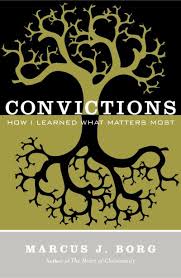 And I'm glad for voices like Marcus Borg who give words to my convictions in ways resonate with my core beliefs. Recently I read his book, Convictions: How I learned What Mattered the Most.
In his opening pages, Borg says this about what progressive Christianity is all about. Here are some my favorite highlights:
I don't know where you find yourself, dear blog reader on the spectrum of Christianity. I hope that you still feel welcome here even if your beliefs are different from mine. Because what I want most for you is what I want most for me when it comes to faith: authenticity.
A place to believe what you actually believe. A place to ask the questions you need to ask. A place to show up without pretenses.
If there's anything I know about what this world needs more of when it comes to religious practice it is telling the truth (even if that leads us from one branch of religion and send on our way to another!). Thanks for listening to mine.
A sermon preached at North Chevy Chase Christian Church in conversation with James 1:17-27
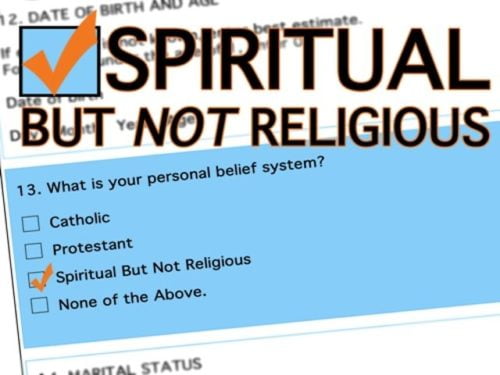 "I'm Spiritual but not Religious" is among the most commonly cited reason why people don’t come to church. Over the years, I've heard:
“Pastor, I don’t think I need to come to church. I’d rather commute with God by watching the birds on Sunday. This is my spirituality.”
“Pastor, I don’t think I’m coming to come to church anymore. It’s nothing against you or the church people. You all are nice and all. I just don’t need a church for my faith.”
“Pastor, I just don’t know how you can stand working for the church. Have you read history books? Have you read the news lately? The church hurts people. I just don’t get how you could be in the ‘religion’ business.”
But, today, I’m musing about this statement, “I’m spiritual but not religious” in hopes of opening up a larger conversation because I've grown weary of the debate.
I want to start by saying that I believe "spiritual but not religious folks," are good people too. They aren't all anti-Jesus. Their lives aren’t completely void of faith practice. In fact, their lives are often full of good and God fearing things. Many seriously pray, read, meditate, etc. with great furor and discipline our scriptures.
So I don’t necessarily think the excuse of “I’m Spiritual but not Religious” is about laziness—but in many cases their devotion to God puts those of us who are “religious” to shame.
But, even with this true—we in the church often feel like our "spiritual but not religious" friends are like the distant step child that we’d just wish would get with the program, stop being so independent and critical of our structures and join our membership rolls.
We often feel tempted to criticize their faith, especially as their attitude of “My faith can survive without your unnecessary institution” seems like a big slap in the face, to what we’ve worked so hard to hold together all of these years.
We feel tempted to talk about their egos without even considering our own.
And even worse, our culture seems to be in their side with the assumption that spirituality is good; religion is bad.
Or, spirituality equals pure faith and God’s presence. Religion equals corruption, human made flawed structures. We find religion in churches. We find God in spirituality.
Yet the book of James has a lot to offer us here.
And while it’s a book that Martin Luther was known to say is the “epistle of straw” saying that its practical approach to faith is not theological enough—I believe that James is an amazing ancient text wrestling what might not be truly modern problem after all.
James wrote to a community of believers concerned about the essence of faith.
In James' time were many who said: “We’d better get our theology in order. We need to write more doctrine.”
And there were others who said, “Theology is well and good, but what does it mean? What does it look like?”
And to these questions James re-directs the conversation back to God. If I were to sum up the entire book for you it would be this: "It's not that I want to throw out all the great work that Apostle Paul has done in other letters helping us to define the essence of faith. But, I do want you to know how to LIVE OUT YOUR FAITH."
For you can talk a good game for a long as you want, have all the right answers with what you think Jesus meant about this and that, but if your life doesn’t SHOW what you believe then it’s all rubbish.
Pure rubbish.
He writes in chapter 1 verses 26-27: “If any think they are religious, and do not bridle their tongues but deceive their hearts, their religion is worthless. Religion that is pure and undefiled before God, the Father, is this: to care for orphans and widows in their distress, and to keep oneself unstained by the world.”
James is saying that religion’s sake is worthless. It’s a simple but profound truth.
For, if we keep up tradition, for tradition’s sake, it’s worthless.
If we conduct church business in a particular way because it how they did it back in 1995, it’s worthless.
If we maintain our buildings for the sake of maintaining our buildings, then it’s worthless.
If we do a program in the church simply because it went over well last year, it could be worthless too.
For James wants us to consider WHY we do what we DO. For going through the motions is not faith. It’s religion.
In my work with churches during interim times, I’m often pushing church leaders to wrestle with questions like this (and sometimes making people mad in the process):
“Why do we always to have all of these standing committees? Why do we keep these bylaws around though they were written for a church 3x our size?”
“Why do we keep on programs that no one attends?”
“Why do we only welcome people who look like us? Why do we not push outside our comfort zones?”
I ask questions to push congregations to consider how well-meaning structures and activities have become “going through the motion activities” instead of active faith . . . the kind of faith where we are living out the gospel: good news for all who hurting the most.
Let me stop here and say that I’m not saying structures are bad. Rather, mindless choices we make in the name of religious tradition never up for reconsideration are. For sometimes traditions and religious teaching and practice can be indeed just this—practice from human hands, flawed and in need of a fresh wind of the Spirit upon it over time.
Because don’t we believe that Spirit is always at work in our world? Don't we believe that God can always do a new thing?
And if this is true, then what God wanted from us and what we spent so much time building in 1980 might not be what God wants from us in 2016, right?
When it all boils down to it—I believe James begs the church of his day and the church of our day to ask ourselves—are you spinning your wheels on building up what matters or are you just spinning your wheels?
Is our religion that of caring for orphans and widows i.e. those in need of compassionate justice in this world, the most vulnerable?
Or is our religion that of building bigger buildings and structures that leave a mark of “we were once here?”
For, if our life together in community falls more in the second camp then, James tells us to re-think our religion.
Anytime I do a funeral service, I find myself repeating a phrase of exhortation to the mourners—a phrase, I hope at least some of them might remember later because it asks them to channel the grief and loss in life well lived in the here and now. I guess I should get some new material but I can’t seem to find a better way to say it.
“When you and I die, only one thing matters: not how much money we have, not how many flowers decorate the alter, not how many people attend, not how many groups or societies we belonged to—only one thing—is it well with our souls? Are our lives in harmony with God? What will profit a man or woman if he or she gains the whole world and loses their own soul?”
To me this is the important stuff of life: is it well with our souls?
So, this brings me to the place where I really want to say to those people who tell them they are too spiritual for church—I understand. I hear your frustrations.
I realize the church can be a messed up place where we don’t talk enough about how things are with our souls. Institutions are like this. Sometimes we make good decisions that bring us together and other times we miss the mark painfully by spending TOO much time organizing ourselves.
But, I also believe the church is where God wants to teach us. Is the church perfect? No. Has it made way more mistakes in its formation, declarations, and judgments than it has for the good of the world? Probably.
Yet, I won’t leave the church, though; it might be a lot easier in the short turn with a lot less meetings (I mean A LOT less meetings!)
Why? My faith is communal. It’s communal with the saints and sinners who have gone before me. I believe the Christian journey,  like that of the Jewish journey or the Muslim journey, is one at requires a lot more “we” than “I.” I need the church’s religion for my spirituality to have a home.
So as you read this my friends, may we not just be those who listen to the word, but are those who DO what it says. This means putting away the excuse or the debate of spiritual vs. religious and getting to work.
Getting to work to bless the homeless.
Getting to work to bless the lonely.
Getting to work to bless the dying.
Getting to work to bless the children.
Getting to work to bless the stranger.
Let us get to work! Let us put away the excuses. And let us live out our faith as the Spirit leads us.
Knowing that no mater if our church building are ever full again-- the calling still remains. Are we listening to the Spirit? Is it well with our souls? Are we blessing who need a blessing the most?
This is our faith. Let's get to work.
 How was Easter just last Sunday?
I don't know about you but for me the emotion, the pace and even the struggle of my Lent discipline feel many moons ago this week . . . as do the moments of singing with gusto "Were You There When They Crucified My Lord?" and "Christ, the Lord is Risen Today!"
But because Easter is a season of the year not just one day, I'm trying to stick with the texts for a just a little bit longer this year.
Though I went with the Luke text for my sermon, I love the John's telling of story too.
In John 20, Jesus meets Mary Magdalene at tomb crying, calls her by name, and she believes instantly that her Teacher is alive.
One commentator describes how interpretations through the ages have tried to understand these words:
"They range from the absurd (Jesus' wounds were still sore) to the fanciful (Having heard of the Eucharistic meal, Mary was wanting Jesus to serve her Holy Communion) to the risqué (Jesus' risen body was naked, so touching was inappropriate!)."
But out of Jesus' mouth, we hear this explanation of his response to Mary saying: "for I haven't yet ascended to the Father."
Or Jesus wasn't finished with his resurrection work. There would be more people to see and meet!
Let me stop here and let you know how I want to protest!
Doesn't Mary deserve all the face time she wants? Hasn't she been through enough drama? Did Jesus really have to say that to her? (Bottom line: I want my Jesus to be gentler to sad Mary's soul).
The more I've thought about them, the more I realize there wasn't any better thing for Jesus to say.
How many times do you and I live with fists clenched onto what we have and to what we know?
How many times do we find ourselves attached to relationships that are nothing more than a security blanket?
How many times do we find something "that works" in our businesses or churches and just want to do over and over? (Hey, if it succeeded in the past, then I'm sure it will work again, right?)
Jesus says let GO of the grand moment. Let GO of the people keep you stuck.
Let GO of the doctrines that we would keep you here at the tomb crying (and there's tons of these aren't there?)
Most of all, our Teacher continued to teach. He says resurrection is a living thing! If it moves, we move. If it dances, we dance. If it re-arranges our schedules, we rearrange!
As much as any of us think we understand God, the purpose of our life, or even think we're "too old" to make any big changes, Jesus says let me show you the world from my resurrected lens.
And while the actual resurrection event is a great one, resurrection is a verb.
It's dipping our toes into all the great unknowns. It's springing wide our doors to new possibilities. It's the best work in fact. The work that has the ability to bring more life to our souls, our homes or our churches more than a blow out Easter day celebration ever could!
So, thank you Jesus for telling Mary to "Not hold on to me." Thank you for telling us the same. For if we just stayed put with you at the tomb, we'd miss out on the adventures you want to give us! Keep us moving, Lord. Keep us moving.
AMEN
Excerpt from sermon preached at Oaklands Presbyterian Church, Laurel, MD on Mark 13:1-8
Mark 13 is an interesting text. It begins this way:
One disciple says to Jesus on the way, “Look, Teacher, what massive stones! What magnificent buildings!” It’s a keen observation of opulence. The glory of the temple was Herod’s doing. He’d created this glorious worship space with an overflowing courtyard by detailed masonry and hand-crafted attention to every spec.
And so Jesus wouldn’t just let their comment go unnoticed.
He fires back right away, “Do you see these great buildings? Not one stone will be left here upon another; all will be thrown out.”
Or, in other words, “Guys, why are you so focused on what is now? Haven’t you heard anything I’ve been saying these months about the kingdom of God?
And so begins a chapter of Jesus’ teaching that could be filed into the apocalyptic category, a category in which symbolic visions are interpreted as a heavenly revealer of something. Or in simpler terms—if you see ______ happening on earth, then it means ____ is happening in heaven.
I have to stop here and say, that apocalyptic passages like this or whole books on this topic like Daniel or Revelation are not my favorite parts of scripture. Though while I don’t mind the definition I just gave of apocalypse (images that help us see beyond the now to the eternal), I don’t find much use for this topic in my daily life, much less preaching on it!
But because this passage came up in the lectionary and I felt drawn to explore it (Oh, Jesus help me)—here we go!
And maybe you’re in the boat with me . . .
You can hang with Jesus through so much but when he starts talking about the signs of times to come, you feel like you’ve read or seen one to many Left Behind books or movies that you’d really rather just skip over sections like Mark 13 and get on to the more normal stuff like the miracles and Jesus loving on the children.
But what might Jesus’ words on the topic of times to come have to offer us this morning?
 Most of the interpretations I’ve heard on this text go like this:
This world is passing away. One day Christ will return. All will be destroyed on earth. Christ followers: watch for the signs. The signs will point us to the knowing of when that one event is about to occur.
In fact, Jesus is giving us signs as he says in verse 7 and 8:
“When you hear of wars and rumors of wars, do not be alarmed. Such things must happen, but the end is still to come. Nation against nation, and kingdom against kingdom. There will be earthquakes in various places and famines. These are the beginning of birth pains.”
And teaching sessions like this would conclude with references to world events that would speak of wars, disputes among tribes, international fighting and earthquakes and famines.
The world is ending sooner than you and I think!
And while teaching like this wants to convict us . . .
If we are good readers of text, some preachers say, we can see the signs. The end is coming. We can know. We can be certain! We won't be left behind if we live right!
The faith tradition I grew up was filled with certainty. There was an answer for everything!
My faith traditions said questions were bad. They were bad because it led to doubt. And good Christians didn’t doubt. Good Christians read their Bible every day and take texts at face value. And good Christians confidently sing hymns like “I Know Whom I Have Believed” and “When We All Get to Heaven.”
For in my world view at the time, I never voiced even a shadow of doubt. For I KNEW where I would go when we died one day. Really, what else mattered?
God as a mystery was out of the question, of course.
So I ask again, is certainty what Jesus was trying to give his disciples in Mark 13? I don’t believe so.
In fact, I believe that Jesus was trying to warn them against the danger of certainty. And all the leaders who think they have it.
Remember with me how this conversation began. The disciples are pointing out something man-made and beautiful. Not that there is anything wrong with admiring the good and the lovely constructed things on earth, but Jesus is doing a total 180 re-direct saying:
Why are you so focused on this over here?
Why not focus on the bigger picture?
This world, my disciples is broken. And because it is broken it will fail you. Unfair things will occur. Really unfair things. Family will rise against family. The lifespan of beloved ones will end short in tragedy. Discomfort will be a part of your earthly experience.
But I have good news for you. (Jesus says) Do not be afraid. Do not be alarmed. Trust me. Exchange trust in me for your certainty.
On Friday, one of the worst tragedies to hit Europe since World War II occurred. A calculated attack, by known terrorists of
open gunfire destroyed and wounded the lives of hundreds out for a weekend night in Paris. No one saw it coming. Places that aren’t normal targets became massacre zones—restaurants, shopping areas, concert halls.
And to say that a wave of shock and deep, deep fear has blanketed the western world these past several hours is an understatement.
For it was Paris—a place rich in beloved tradition, culture and freedom. And it was the place of all places attacked.
And to hear the French President and even the Pope chime in and say, “This is the beginning of the a third World War. . . . France will never be the same.”
It’s scary stuff. To all our ears. Really scary.
It feels congruent with Jesus’ words “when you hear of wars and rumors of wars.”
Or, like I read in one online clergy chat room yesterday, “Are we living in the pages of Mark 13? I think so!”
Maybe we are. Maybe we aren’t.
Certainty puts the focus of our lives on what we know, which of course is always limited and never the full story. And if gone unchecked for a while, certainty makes us arrogant in ways that keep us from loving God and our neighbor with our whole heart.
I heard the mayor of New York City in one such interview talking about all the additional security measures in place in his town— more road blocks, more police, more checkpoints, all designed to make people feel safe.
I knew why he said what he did. Words like this are a normal part of the reaction to devastating tragedies. It’s what we crave to hear!
We want human saviors who build more walls, collect more guns and will do whatever it takes to protect us and those we love.
We want reassurance that our world is safer than we think, that our borders are able to keep terror at bay, and that our children and our children’s children will grow up surrounded by greater world peace than we’ve known in our lifetime.
But, is that possible?
If the answer is truthfully no, then how then do we live?
Several weeks ago, my colleague and friend, Rev. Allyson Robinson penned an article about a moment of deep life revelation. It boiled down to this for her, her faith was built on certainty.
Rev. Allyson wrote: “Certainty, I soon discovered is like a drug. It can comfort us, buoying our spirits as it blocks out the questions, but only for a time. When the mellow high of certainty wears off and the questions reassert themselves, as they always do, we’re sent running in search of a new fix. Certainty is addictive.”
But she realized like any addiction, she needed to let it go. She could not be the human being God had made her to be and be certain at the same time.
Allyson talks about her recovery like this: “I had to get used to carrying the weight of the questions, and I had to learn to accept my own limitations, not fear them. I had to learn to trust God to love me even when I’m not sure, and even when I am wrong.”
My friends, I believe, you and I have before us the same process too if we want to live into the good news this week:
Carrying the weight of our questions.
Accepting our own limitations, not fearing them.
Trusting that God can love us even when we aren’t sure.
And most of all believing that sometimes what we most know can be wrong.
The world needs us to band together reminding each other: “Do not be afraid.”
For this world is ultimately not our home, in all it’s jewels and splendor.
Whatever will be will be.This is for sure!
The cost of discipleship is great. Just look at Jesus.
Yet no matter what, the Holy Spirit will never leave us.
So let us love God, love one another and be brave when times get tough.
The Great Mystery will lead us all home, even if we can't see one foot in front of us. All will be well.
Thanks be to God for this gift in uncertain times. AMEN
A Sermon Preached at The Federated Church, Weatherford, OK on Luke 24:13-33
 There’s a country song by Miranda Lambert that I became familiar with several years ago. I loved when it first came on the radio because it reminded me so much of the small town in Georgia where Kevin grew up and we were married. Maybe the words of, “Famous in a Small Town” might remind you of what it’s like to live in Weatherford.
I dreamed of going to Nashville
Put my money down and placed my bet
But I just got the first buck of the season
I made the front page of the Turner "Town Gazette"
Tyler and Casey broke up
It ended pretty quietly
We heard he was caught red-handed with her mama
That's just what they let us all believe
Every last one, route one, rural heart's got a story to tell
Every grandma, in law, ex girlfriend
Maybe knows you just a little too well
Whether you're late for church or you're stuck in jail
Hey words gonna get around
Everybody dies famous in a small town.
And if any of these words call to mind experiences you’ve had, then you’re right on track for understanding the mood of our gospel lesson for this morning. For in a small town outside of Jerusalem, word had gotten around town and somebody named Jesus just died famous.
And so, on Easter evening, it was all the talk at the local gathering places. It was all the talk at the village market. It was all the talk as the kids began to stir again after they’ve were cooped up by their parents during the Passover festival for days.
It was all the talk as two men, one who we know as Cleopas and the other without a name travel on the road from Jerusalem to Emmaus. Jesus had just died and there was so much gossip to sort through!
And it all got all the murkier when another traveler started walking beside them. He overhears their conversation and approaches them with the question, “What are you discussing with each other while you were walking along?”
The travelers having no idea that Jesus—the man who had supposedly died—is among them. So Cleopas answers him saying, “Are you the only stranger in Jerusalem who does not know the things that have taken place there in these days?”
Or in other words, “Have you not been on Jerusalem’s Facebook page? Didn’t you see the nightly news? Have you not read the newspaper? EVERYONE knows what happened to Jesus . . .” the man who was mighty in deed and word before God and all people, the man that we hoped would be the one who would redeem Israel” but is no longer with us.
Oh, kind sir, do you live under a rock??
It’s a great sketch for a comedy show, isn’t it?
But Jesus plays along, listening carefully until it was his turn to speak. He’s got a lot to say, though not what you might think. Jesus does not tell the men who is. But, rather, he begins his teaching session.
I can imagine that these two disciples were pretty smart guys. The traditions of ancient scripture meant something to them. They’d heard these stories before. And they were all ears!
He walks these two through all the prophecies of old beginning with Moses. He carefully outlines for them how the prophecies foretold the coming a Messiah who would endure suffering and death but would rise again. He enlivens their hopes with the joyous possibilities that Jesus could be alive!
Just like some of us might feel going to a convention or a conference in our chosen profession, surrounded by thousands of people who think and engage the world like us, so these disciples were “geeking out” on Jesus. They could not get enough of what he was saying! Being with such a wise teacher with such a commanding presence was just so sweet! They wanted to learn as much as they could. So that when they finally reached their destination, they didn’t want their night with Jesus to end.
I know the feeling don’t you? Being engulfed in a conversation that you wish could go on forever or at least late into the night.
As for the disciples, they try to come up with whatever they can to keep things going longer! Verse 29 tells us that “they urged [Jesus] strongly, saying, ‘Stay with us’” And so Jesus did.

Conversation that was beyond the superficial stuff we normally fill the airwaves with the most—
“I am making chicken for dinner with a new recipe I just saw online” and “I bought a really nice pair of shoes today on sale.”
Conservation that was beyond the stuff we talk about when we think we’re talking about something more important—
“My son is was offered a new job last week that will give his family more financial security” and “Retirement really does suit me; I like not having to get up early in the mornings.”
Conversation that was beyond even the stuff we talk about in religious circles—
“We need to pray for so and so who is sick” and “I really liked that Bible study. Can we do something like that again?”
No, the conversation between the two disciples and Jesus that day was a heart to heart. It was conversation that touched tender points of discouragement, dreams and fears within their souls. It was a conversation that they needed answers on and needed answers now. For their beloved teacher had died and nothing would ever feel the same without him.
So, what really did all of this news around town mean?Jesus gave answers that were profound and like none they’d ever heard. And it was a lot to take in—so much so that they were in the dark about the LIGHT walking alongside of them for most of the talk until . . .
POOF! They all sat down together at the table, broke bread (which has a lot of unspoken allusions to our communion meal) and verse 31 tells us that “Their eyes were opened and they recognized him.”
Jesus vanishes—for his conversation task was over.
And we see the significance of what just occurred as the disciples respond to what has just happened to them.
I resonate so deeply with this verse of scripture because I feel so much it’s what my work as pastor/ preacher is all about. If I am going to be a leader who helps a congregation have an experience with Jesus then I’ll know that I’ve done my job if they reflect back to me a version of your “hearts burning within you” story while I’ve been teaching.
I also resonate with me because I feel my own faith journey is rooted in conversation. I am who I am because of the countless folks I’ve encountered in my life who felt enough conviction about their faith to talk to me about it.
And in everyday life, when you and I break bread together or enjoy a cup of coffee and I can share my stories with you and be heard with empathy and you can share your stories with me and be heard with compassion—then to me this is a Road to Emmaus experience. We both learn something new for the journey. Why? Because Jesus is present! And what’s better than that?
But as much as I share my excitement for conversation with you this morning, I also know that for some of you it’s not your style.
You speak when spoken to. You share your deepest thoughts to someone maybe once a year. And a room full of people having conversation about a book or a faith experience makes you want to run for the hills and not come back till the room is cleared out. (And I affirm you though I might not understand you as much as I do the sharers).
Because my friends, when resurrection comes to your life and mine, and I mean, mind boggling, I can’t believe this is happening, I never thought this was possible kind of new life resurrection, then you can’t NOT talk about it. It’s just too good news to share!
Jesus was alive and he couldn’t not converse with these disciples about the good news!
The disciples loved Jesus and they couldn’t not converse with one another about all that Jesus had meant in their lives!
And for all of us who’ve had a resurrection experience, we can’t not talk about it with each other.
When I was in Christian History class in seminary, one particular saint story caught my attention and it came from the life of Teresa of Avila.
Teresa, if you don’t know about her was a nun within the 15th century. Her writings like “The Inner Castle” make famous her mystical experiences of God in prayer. Teresa is a “straight from the hip” kind of saint especially on matters of prayer and what being in the presence of God feels like. In her time, people thought she was crazy sometimes because she endured great bouts of depression and sadness. But regardless of what others said about her “resurrection experiences” she was authentic voice during a difficult time in the church. She eventually became known as a great church reformer, though not given any recognition for such during her lifetime.
And this is one of her famous prayers: “Christ has no body now but yours. No hands, no feet on earth but yours. Yours are the eyes through which he looks compassion on this world. Yours are the feet with which he walks to do good. Yours are the hands through which he blesses all the world. Yours are the hands, yours are the feet, yours are the eyes, you are his body. Christ has no body now on earth but yours.”
Isn’t it just beautiful?
Though we might be afraid to talk about what God is doing in our lives, Christ has no body now in this place and time than yours.
Though we might not want to be perceived as the “overly religious one” in a group as the one who stops to pray when something good happens, Christ has no hands on earth but yours.
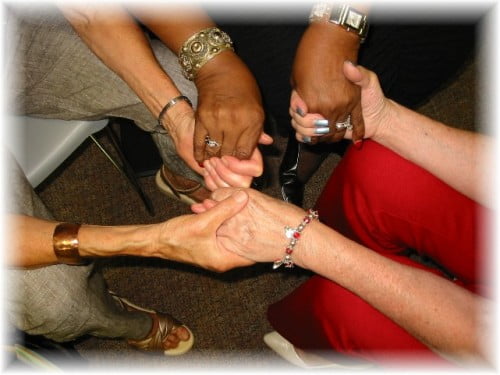
Though we might not want to offend someone by bringing up the good news of what is happening in our church to someone who hasn’t been here in a while, Christ has no feet on earth but yours.
And I say all of this with an understanding of the context where I am preaching. This is Oklahoma. Christianity is everywhere. People pray before meals at restaurants all the time. People talk about this and that event with their church all the time. People quote Bible verses in places of secular business all the time.
I’m not talking about any of that.
I’m talking about the stuff of our lives that is deep and profound. The stuff that keeps you and me up at night. The worries that trouble our souls and make us want to weep—all the stuff that the disciples had at the forefront of their minds on the road to Emmaus that day.
When that stuff bubbles up and when God does a work in you or you’re desperate for God to change something in you, then you’ve got to talk about it.
Resurrection is not a silent way of life. It’s a vocal one.
It’s a way of life that comes not only in words but gestures of the heart, gestures like invitations to dinner. Gestures like long meals unrushed toward what comes next. Gestures like speaking truth when it wells up in our throats, “Were not our hearts burning within us while we talked?”
So, my friends, Christ has no body on earth but yours—so if we want our message of God’s love and acceptance for all to spread, then let’s start talking!
Christ is risen. Christ is risen indeed! We've got a great story to tell as it unfolds in you and me!
AMEN
 When I was growing up in the Southern Baptist Church, I learned the Christian life was about these things:
I don't think my faith is could be measured by any of these acts anymore, but it doesn't mean I've thrown scripture out.
Paul had some words to share on the manner to the church in Philippi. As his parting gift to this congregation that had meant to so much to him as a missionary and preacher—he too wrestles with the question of what does it mean to live a Christian life.
The book of Philippians is the known as one of the happiest books in the Bible. It’s one of those books that you just feel inspired and convicted by all at the same time. It’s a book often cited by many Christians as their favorite book of the Bible. And I have to say it tops the favorite list for me.
But there's one catch about this book: Paul is writing while in prison. He’s been put in chains in Rome on behalf of his faith that the governmental leaders at the time didn’t like too much. His death might be near.
It’s almost like Philippians becomes his last word and testament: everything Paul has always wanted to say (or say again) and hasn’t had a chance yet.
And by time we reach chapter 3, we’ve gotten to know Paul at deeper level when he boldly proclaims that “everything was a loss in comparison of the gift of knowing Jesus” and that most of all Paul wants “to know the power of his resurrection and share in the fellowship of his sufferings.”
So, when we reach chapter 4, I can imagine that some of the readers of this letter were bursting, were overflowing, were saying, “Stop, stop, Paul. You’ve given us so much to take in. We can’t take any more.”
But what Paul does is give them more. Every good speech needs a strong concluding hook, right? Every great race needs a victory lap right? Every want-a-be graduate of the ways of Jesus needs “This is now how you live,” right?
And so we arrive at: “Advice for the Christian Life by Paul.”
Several years ago, Katie Couric, popular news anchor and journalist—was asked to give the commencement address at a university in Cleveland, OH. Quickly, she found herself in a quandary as to what to say. She wanted to do a good job, and thought of the idea of crowd sourcing many of her famous friends, asking as many the question: “What was some the best advice you’ve ever gotten?”
Katie was overwhelmed by the response and the generosity of time and thought of many that she began piecing all of the responses together—not just for this one commencement address but for a book published in 2011 called, The Best Advice I’ve Ever Gotten.
One such entry in Katie’s book came from, Joyce Carol Oats, award-winning author, poet and playwright. She offered advice to any young people seeking to walk in her footsteps with these words:
Don’t be discouraged!
Don’t be envious of others!
Read widely—what you want to read, and not what someone suggests you should read.
Forget “should.”
Don’t expect to be treated justly by the world, though you might try to treat others justly.
Don’t too quickly cut yourself off from the possibilities of experience.
Don’t give up. What is to say, don’t be discouraged!
Take all advice with the proverbial grain of salt.
And even if we are not aspiring to be writers or artists—Joyce Carol Oats gives us some pretty wise offerings, don’t you think, in all her direct, staccato like statements?
Paul’s edition of “The Best Advice I have to give you” comes to us in a similar fashion. It’s clearly to the point that you can almost feel him in the room beside as he’s saying these words:
“Rejoice in the Lord always. Again I say rejoice. Let your gentleness be known to everyone. The Lord is near. Do not worry about anything, but by prayer and supplications present your requests to God. And the peace of God that passes all understanding will guard your heart and mind in Christ Jesus.”
What’s most interesting to me about this text is how much Paul changes gears from chapter 3 to chapter 4. In chapter 3, we almost feel out of breath with him in the running the race metaphors and fighting the good fight.
But Paul's “best advice ever given” starts with: “Therefore, my brothers and sisters . . . stand firm in the Lord.”
Stand firm is a very different from pressing on the race isn’t it?
 Trying to reconciling these images is complicated! But one of my professors from seminary; Susan Eastman offers some suggestions saying that the answer lies in the prepositional cause “in the Lord.”
Eastman writes, “In the Lord, our forward movement [in the spiritual life] is like our constant movement on the surface of the earth; we are held fast by gravity at the center . . . constantly in motion but also constantly at rest.”
She goes on to say that we can’t just be in motion, doing, doing, and doing all the time in our spiritual lives without rest because: “Without this center of gravity, this grounding in the settled presence of Christ . . . the life of faith as a race quickly become frenetic and destructive.”
Or in other words—Paul is saying the Christian life is not just about what we do but it is about how we’re standing and who’s holding us. And that’s Jesus.
Yes, we strive for the spiritual disciplines to know Him and we run the best race we can. But, at the same time we remain planted in Lord. We wait upon the Lord. We are still. We allow the Lord to do what only the Lord can—which is of course a great mystery to us.
We do so because the kingdom of Jesus abides in a whole other reality—a reality that is not based on what we see, what we can rationally prove, or even how we feel about our lives on any given day. And this reality is what Paul exhorts us to stand firm in. Just as David wrote about in the great Psalm of the church: “The Lord is my Shepherd. I shall not want. He leads me by still waters . . . “
For the Christian life, my friends, is not just about what we do. The kingdom of Jesus is about something much deeper and embodied. So in the end, this passage which at first glance may appear to be a laundry list of instructions for living—becomes words that point back to Jesus. The One who simply asks us to stand firm.
So, how do you live the Christian life? When in doubt, stand firm. Jesus will take care of the rest! No evangelical checklist needed.
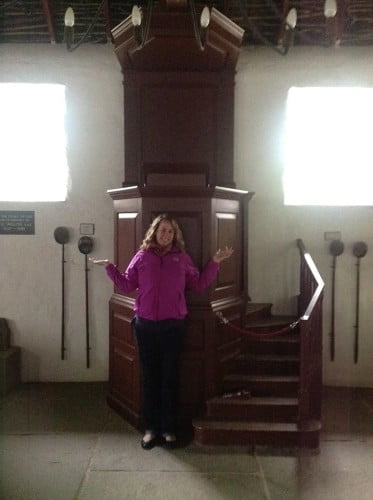 If you could go back and have a conversation with yourself, 10, 20 or 30 years ago, what would you talk about?
I know I'd have much to say.
When I was in high school, I was extremely lonely. I felt like no one really knew who I was. I was words like "too serious" and "too Christian" and "nerd" would be words other people used to describe me.
Needless to say, I didn't run in the popular crowd. I never had the right clothes or found myself in activities that achieved instant coolness. At school I only had one real friend. I think depression was something that I dealt with though I didn't have the words to describe it yet.
But, even with the awkwardness, I had some self-awareness.
I knew I liked encouraging others.
I knew I liked organizing and leading things with purpose and that validated others' gifts.
I knew I liked paying careful attention to the details of others' lives so to connect with them intentionally.
I knew I liked public speaking and got great joy out of someone receiving hope from something I said.
But, in all of these good gifts I felt completely defeated because I lived under a value system where none of these heart bursts of mine were assigned much if any value. Women in my church were not even allowed to usher, much less preach.
So, instead, tried to be what others saw as "good." And you could imagine how well that went over . . .
I really tried, BUT
I wasn't good at sports. (I even got a C+ in PE once because of my kept falling off the aerobics bench during the routines).
I wasn't good at voicing my opinions in a crowd therefore I never got elected to student council.
I wasn't good at telling others that I needed them. I wondered why people didn't seem to like me as much as I liked them . . .
I just couldn't find my niche. I sat beside the teachers and the adults on the bus trips. But they didn't know what to do with me either.
Deep pains from this time in my life still eat at me now, if I let it. So, I could have become full of rage. I could have started living into destructive patterns of behavior. I could have rejected the faith I was given as a child. And, I'm sure no one from outside the bubble in which I lived would have blamed me.
But, in all of this mess, my life was saved, I know, because I was given this grace from God: to write. In my writing, I could figure out life. There might be a better way I could live one day?
Though I didn't have words to articulate this concisely at all, I knew what direction my life was going. I put pen to paper.
And gradually as I kept living, I found friends, mentors and colleagues who with great patience would beat it into my head that I was loved and that my gifts mattered.
I knew I had to fight for my own life, even if no one else did. Because my life mattered. And, I needed to live out my calling to BE the woman God created me to be, even if the Southern Baptist Church frowned on me. Otherwise my soul might start to die.
And, I'm so glad I did. I'm glad I choose seminary. I'm so glad I married Kevin Hagan. I'm so glad I became a pastor. I'm glad I'm continuing to learn what it means to be the "Preacher on the Plaza" on days like this one.
Consider the writings of Parker Palmer who says, listen to your life.
Let your life talk back to you. Let the divine gift of direction swell up in you and don't be afraid to believe in your own blessedness.
No matter if no one but you recognizes it at the time and not matter how much you feel beat down, keep believing and soon others will too.
So for me, if I could go back to high school, I'd have a long talk with myself about just hanging in their till the good stuff started.
"Life will get better for you, Elizabeth. It will. I promise!"
What would you say to you?
 We live in a growing interfaith world.
We simply do not marry or interact or learn from people who come from the same exact faith background as us.
Rarely do any us stay "one thing" our whole life without influence from another tradition. And, because of social media, have so many opportunities to know who God by route of those who might call God a different name than us.
Today I'm sharing the story of how I released the exclusive beliefs of my childhood through relationships with interfaith friends. I know the teachers of my evangelical past might say that I've lost my way, but I've chosen love and shared wisdom over judgment. Here's my surprising conversion:
The first time I heard the phrase “God is too big for any one religion” I was in seminary in North Carolina.This statement was found on a bumper sticker on my roommate’s car. I looked at it every morning when I walked out of the house to go to school. I was intrigued, but confused.
Growing up with a “Jesus is the only way to God” upbringing, I had no idea about what to think of my Baptist soon-to-be clergy friend’s bold declaration on her car.
Was she crazy being so public about her inclusive theology in the Bible Belt? I worried about her safety on the road.
Several years later I found myself pastoring full-time in the Washington DC area—the land of much cultural and ideological diversity. In my free time, I dated Kevin, also a Baptist, who lived in a shared house in the city with two other guys. I liked them a lot. They were funny, smart and accepting of my growing presence in their home. They just so happened to be Hindu and Baha’i.
Read the rest over at my friend, Rev. J. Dana Trent's blog.
