Over the course of our travels and many meetings with Feed the Children staff, partners and other NGO leaders there is one question I find myself asking these folks over and over: "Why do you do this work?"
The answers I have gotten from Africans and expats alike have varied but the heart of all of them has come back to calling.
"We are here to serve because we can do nothing else, be nowhere else."
In fact, a line that was said in our program with the staff last Saturday as part of the litany of blessing for the week ahead was "God has called us to serve." Drivers were called to serve. Cooks were called to serve. Administrators were called to serve. All staff of Feed the Children, we said together were called to serve.
In my pastoral work, I talk a lot about calling. I preach a lot about calling texts in scriptures. And I even call out the callings in others when I sit with folks in counseling sessions. But somehow hearing about the motivation behind why the many here on the ground here do what they do has made me stop to ponder calling once again.
Calling I believe is more beautiful than I ever imagined. For, as I have observed it and even felt it in my own heart, I have observed calling as a gift. It's a gift that can ground the right people in the right situations even if these are circumstances that others many call difficult or unimaginable. Calling is God's way of helping us be in the place where we are blessed by our giving and receiving.
When you have a calling, you can't say no even when it leads you to feed hungry children in the smelly slums.
When you have a calling, you can't say no even it leads you to remote villages to love on kids on bumpy roads for long hours.
When you have a calling, you can't say no even if it wrecks the plans you previously had for your life only one day before.
I am excited to continue to support the work of Feed the Children through Kevin's calling to be there and thus mine in some way too. I truly consider this time in our lives all the joy. How did I get to be so lucky?
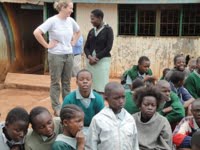
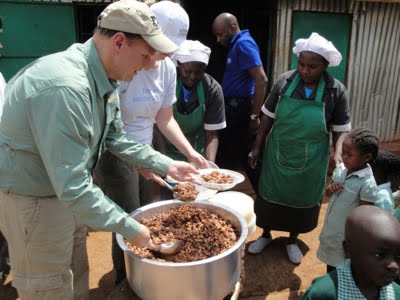
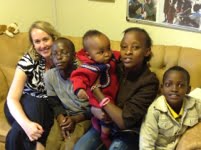

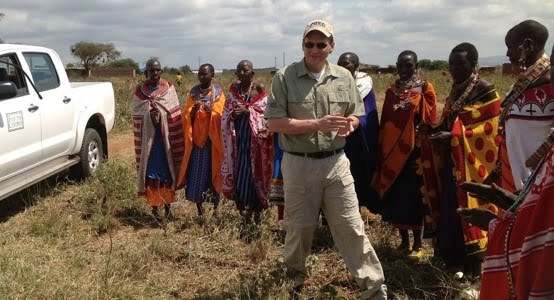
Today, our delegation toured, observed, and participated in the work of Feed the Children Kenya in the Maparasha, a remote village community of the Masai tribe.
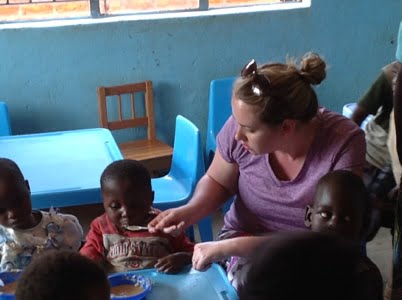
We saw a water sanitation project in action as women and children gathered water from a clean well instead of walking 5 km up a hill to a remote water source. We visited with school children in an early learning center who received lunch of corn and beans from Feed the Children's distribution. (Kevin and I even got to serve the meal to the kids who came through the line with their tin bowls). We visited an AIDS education training session. We met with mothers at an nutritional seminar at the community birthing center-- watching lessons on how mothers can best feed their family.
I felt proud today to be connected to the larger Feed the Children family.
However, in all of these accomplishments, there is always so much more that that just isn't getting done because lack of resources.
Children have shoes but they are tattered and falling off their feet. Children have uniforms on, yes, but they have holes in them. Children eat lunch but the school only has a few number of bowls so everyone must eat in shifts. Yes, there is clean water from the pipes, but in dry season there's still not enough water to go around so that water is only available two days a week.
Feed the Children like other NGOs needs more funds to support even more sustainable projects. And while many of us in theory care for the poor and want to help out, we look at our monthly budgets and say there is no way that I can give or give more. The big issue of child hunger and poverty seems too overwhelming to even try to involve ourselves in. Or if we are givers, we do so without a lot of hope that our small donations can make a difference. We have no connection to the larger human family that needs all of us to give and take.
I remembered today in all of my thinking about this a sermon illustration I used many months ago by Tony Campelo that seems to apply well here.
In 2003, I attended a meeting of the Cooperative Baptist Fellowship in Charlotte, NC where seminary professor and social advocate, Tony Campolo spoke. It came time to give the offering for missions after the sermon. And, the gentleman guiding the program asked Tony to pray before the ushers came forward to receive the offering. Seemed like a very normal churchy thing to do.
However, to the shock of many, Tony refused to pray. “What?!?” we were all thinking in our seats. Instead he said something like this: “We don’t need to pray for the offering tonight because this is what I know about God. God has already given each us in this room enough resources to meet our $15,000 offering tonight. All we need to do now is to give. So, I’ll start by emptying my wallet with the cash in it and maybe some of you could do the same.”
And, just like Tony said that night, we got our $15,000 plus mission offering plus some in that very room.
And it is the truth. God has given us every resource we need to do what we are called to accomplish. We have the money. We really already have it. It is just up to each of us to do our part. Or in this case, give so that many more kids around the world have life's most basic necessities.
I know I am catching more fire in me for advocacy work this week. You simply can't see needs and not be changed in return.
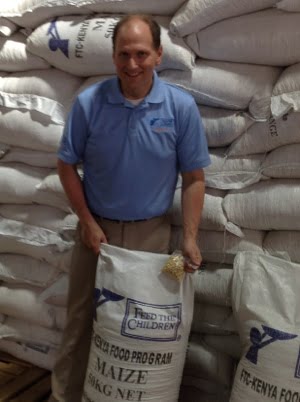
Often times in the church, we think of spiritual disciplines as a practice which we can qualify as holy action. Practices like praying, reading scripture, doing works of charity and the like are often the prescriptions for spiritual growth.
But Barbara Brown Taylor in her book, Altar in the World (which we at Washington Plaza along with our friends at Martin Luther King Christian will be studying together this fall), speaks of how we find God in the most ordinary of circumstances. Altars she writes can be anywhere we encounter the holy. It's a discipline for all of us to simply pay attention.
This week, while on travel in Kenya and Malawi, I have a new altar to add to my list and that is international travel.
As many of you know who have traveled throughout the developing world, nothing ever moves as fast as it does in the United States or even Europe. Not that it is bad (I happen to like the change) but it is simply different.
Bags get lost easily on flights.
Traffic jams on narrow roads make getting from one place to another a chore.
You look for something you need and can't find it.
Water that was once warm becomes stone cold.
The electricity goes out for no apparent reason.
And it is just life.
In these circumstances as a non native you have a choice. You can get angry. You can grow in misery of why things aren't the way you wish they were.
Or you can go with the flow. You can embrace the moment. And you can accept the challenge as a spiritual discipline.
What might God be saying to me about who is ultimately in control?
What might be learned about enjoying the company for the journey instead of being so consumed in reaching the destination?
What might I really need instead of just want for my personal comfort?
I am having fun this week in these out of the norm circumstances, hoping that if I embrace them I might just learn more about myself and God's ways of being with us in the process.
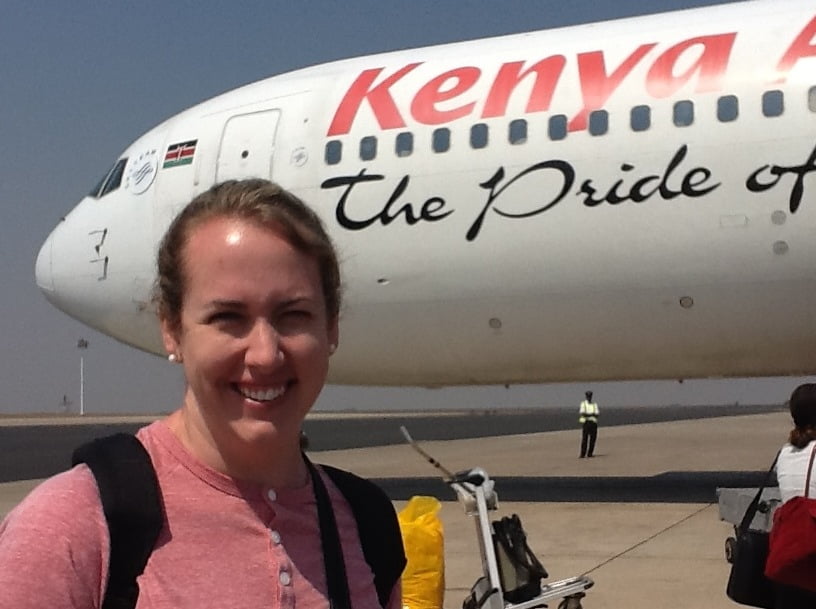
We have now been in Kenya for two and a half days-- a country where Feed the Children has a strong presence through its work in the slums, with orphans and also in villages too. I shared a devotion with the entire Kenya staff of over 200 folks, toured the Feed the Children center, spent the night at a group home for the disabled, had "church" at a orphanage for abandoned elephants, dined with staff and much more! In response of seeking to take it all in, I am overwhelmed with thanksgiving.
We have met children without parents from babies to teens who have grabbed onto our legs and haven't wanted to let us go.
We have met caregivers of children who have welcomed Kevin and I with hearts full of love and support for the ministry that lies ahead.
We have met administrative staff who have blown us away with their commitment to love the under served.
We have met drivers who have with care driven us from place to place in an unfamiliar city and told us stories about their heart warming experiences with the children too.
We have met young men with learning and physical challenges that have delighted in our company not because we did anything special other than stop and spent time with them.
We have met folks of all kinds connected to the Feed the Children family who have made the distance between stranger and friend seem so very small.
In all of these things, we found ourselves on holy ground. Tears have flowed. God's spirit has been present. We have nothing to offer back except "thank you." There is no better feeling than to be in this kind of joy.
Kevin and I thank God for our calling to be here this week and for all the ways that this opportunity connects us to our larger human family. More blessing reports to come, I am sure. But for now before my unpredictable WiFi connection goes away, I will sign out in gratitude. Be well wherever you are!


On the day of the announcement that Kevin would soon become the CEO of Feed the Children, a reporter asked him "You are not going to do any more of those commercials with African children starving with flies on their faces are you?" Looking a little taken aback by the directness of the question, Kevin replied: "No I don't think so" to which I as an onlooker smiled. Emotional manipulation-- my perception of such ads-- is not something I am a fan of and I am glad my husband wasn't either.
Fast forward three months: a work trip was planned for Kevin to see the field sites of what Feed the Children is up to for the first time overseas. I tagged along for the journey. Having already been to Africa twice, I wanted to see Kevin in this kind of environment-- a environment that had helped to shape my becoming as a young adult. Boarding our plane in DC on Sunday for Malawi by way of Ethiopia, I was game for anything. But had no idea what this adventure would entail.
Once we arrived and had a night to get some rest, we rose early on Wednesday morning to make a visit to a village where Feed the Children leads the way in making transformational change. Most of the inhabitants of the community are substance farmers who if they were lucky grew enough sweet potatoes, maize or tobacco to sell with some or any profits.
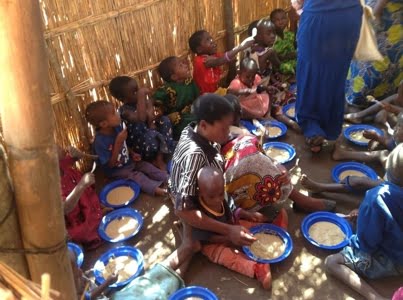
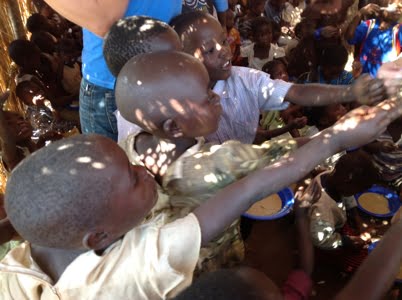
As we visited with crowds gathered to welcome us, we soon learned about how the great partnership between Feed the Children and Nu Skin helps to feed children at the most critical stages of development (ages 2-5years) with a supplemented porridge called Vitameal. We watched the distribution of the meal as the trained mothers from within the community gave it to all the children in the early learning program (over 70 of them) as they gathered under a temporary shelter made of straw.
I saw faces of smiling kids eating porridge that I knew was saving their lives.
I saw fathers full of hope for their children's future because how well they were eating prior to what it had been before the coming of Feed the Children to their village.
I saw mothers, young children themselves, openly nursing their babies with contentment.
I felt welcomed into this village straight out of a National Geographic photo shoot as we were given a tour of the other initiatives Feed the Children has brought to the community including health and sanitation education, clean water, and a village savings and loan for business development.
Later in the afternoon, we visited a preschool for kids with disabilities and the malnourished where Feed the Children provides Vitameal. This was one of Lilongwe's poorest districts whose centers are thriving based on the kindness of private donations from well wishers.
I saw mothers, sisters, and aunts wiping drooling mouths of older toddlers unable to sit alone.
I saw children deemed unfit to attend school working on their fine motor skills by working puzzles.
I saw teachers making the best of their inadequate resources as they sought to inspire kids with catchy songs with shapes and colors in them.
Over the course of the afternoon, along with the rest of the group (6 of us in all), I spent time with these kids and then got to feed some of them their porridge as part of their pre-home ritual.
In reflection later of the day, I realized how naive my resistance to "starving children in Africa with flies on their faces" truly was. It is in fact real. I met these kids. I held these kids. And though Feed the Children is doing great work, there is still so much more to do. And there are even children involved in their sites that have a long way to go in terms of actually being healthy and their parents being able to take care of them without a complete dependence on the Vitameal.
Yes, we have kids in need in our country. There is hunger everywhere. But for this week, I am glad I got to experience both the joys and the deep challenges of the faces of poverty in Africa.
Though I may still roll my eyes at the sappy commercials as they play on late night TV, after my trip this week I will give testimony that childhood hunger is real. It's a cause that needs more advocates, more funding and more compassionate laborers to attend to the work.
I’m Spiritual but Not Religious: James 1:17-27
 Today’s excuse in our "Excuses" series is among the most commonly cited why people don’t come to church. I’ve heard countless versions of it during my tenure as Pastor at Washington Plaza, even.
“Pastor, I don’t think I need to come to church. I’d rather commute with God by watching the birds on Sunday. This is my spirituality.”
“Pastor, I don’t think I’m coming to come to church anymore. It’s nothing against you or the church people. You all are nice and all. I just don’t need a church and it’s religion for my faith.”
“Pastor, I just don’t know how you can stand working for the institutional church. Have you read history books? Have you read the news lately? The church hurts people. I just don’t get how you could be in the ‘religion’ business.”
And, as I’m preaching to the faithful this morning, a crowd gathered here to worship God in August (yes, the traditional low attendance month in churches across the country), I know I’m preaching to the choir. I’m preaching today to a congregation of folks who apparently aren’t hung up in all of the “spiritual vs. religion” cultural debates because you are here. You understand the importance of a communal spiritual life. And different from some of your peers, you’ve been able to reconcile the idea of your spiritual life finding a home in an institutional house of worship, in particular Washington Plaza Baptist Church.
But, today, I’m musing about this statement, “I’m spiritual but not religious” in hopes of opening up a larger conversation that I hope we can continue together later around the lunch tables in the Plaza room. It’s a conversation we need to have and keep having together. Because most of all it’s a topic that we in the modern church must stop fighting snarky word wars over. Instead, we must commit ourselves to understanding why the “spiritual but not religious” folks are among the fastest growing group of seekers in our country.
The thing is—you can find very passionate, insightful and God-loving people on either side. Though we are quick to judge, no matter where we stand on it.
Those of us who choose to practice our faith in the context of a community called a church often do so for more than just reasons of “It’s what I’ve always done” or “It’s what my parents brought me up to believe.” Those who make church membership and attendance a priority in their lives often say that God meets them in worship, in study groups with fellow disciples, and in close-knit fellowship of community life. We aren’t necessarily without a rich inner life that those in the spiritual community boast they only found outside the church.
And in the same way, spiritual but not religious folks, are good people too. Many of them think Jesus is a pretty rad dude and frame their lives around his teaching. Their lives aren’t void of faith practice. In fact, they often are full of them! The seriously spiritual pray, read, meditate, etc. with great furor and discipline. And because of this emphasis on preparation for the divine, they often use their keen intuition to seek out God wherever they find themselves—places those of us with our heads in the church might miss. It’s not a question of laziness—but in many cases actually a choice based on hard work that puts the “religious” to shame.
But, even with this true—we in the church often feel like our spiritual but not religious friends are the distant step child that we’d just wish would get with the program, stop being so independent and critical of our structures and join our membership rolls.
We often feel tempted to criticize their faith, especially as their attitude of “My faith can survive without your unnecessary institution” seems like a big slap in the face, to what we’ve worked so hard to hold together all of these years. We feel tempted to talk about their egos without even considering our own. And, in light of this, I could easily stop this sermon this morning and invite us to all go home and re-read the Prodigal Son story from the perspective of the older son who got mad when the son left home and the father loved him the wayward younger son the same . . . But I’ll wait for that exhortation for later.
But regardless, our culture seems operate with these assumptions—spirituality is good; religion is bad.
Spirituality equals pure faith and God’s presence. Religion equals corruption, human made flawed structures.
We find religion in churches. We find God in spirituality.
Yet, into this conversation enters our New Testament lesson for this morning, taken from the book of James, most likely written by James, the brother of Jesus. And while it’s a book that Martin Luther was known to say is the “epistle of straw” for its practical approach to faith instead of theological—it’s ancient text wrestling what might not be truly modern problem after all.
To the community in which James wrote, a group of believers in Jesus struggled with how much this new movement called Christianity was about truth statements and how much it was about actions which spoke without words.
Though there were many who said: “We’d better get our theology in order. We need to write more doctrine.” There were others who said, “Theology is well and good, but what does it mean? What does it look like?”
And to these questions James answers by saying let me tell you more about who God is and what that means to you. It’s not that I want to throw out all the great work that Paul has done, helping us to understand the essence of faith. But, I do want to tell you something else and that is this basic wisdom: you can talk a good game for a long as you want, have all the right answers with what you think Jesus meant about this and that, but if your life doesn’t show what you believe then it’s all rubbish. Pure rubbish
Look with me at verses 26 and 27: “If any think they are religious, and do not bridle their tongues but deceive their hearts, their religion is worthless. Religion that is pure and undefiled before God, the Father, is this: to care for orphans and widows in their distress, and to keep oneself unstained by the world.”
James is getting to the heart of the manner which is religion for religion’s sake is worthless. Yes, truly! If we keep up tradition, for tradition’s 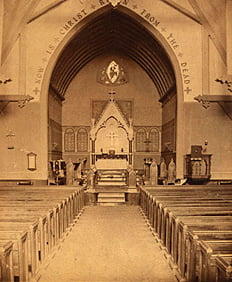 sake, it’s worthless.
If we conduct church business in a particular way because it how they did it back in 1995, it’s worthless.
If we maintain our buildings for the sake of maintaining our buildings, then it’s worthless.
And it’s not that traditions are bad or religious structures like church buildings are evil. But, rather, James exhorts us, that if we do not consider why it is that we do certain things and have certain things then, we really shouldn’t call this faith. We should call it religion for all we are doing is maintaining the framework of what has led us to God in the past but is not necessarily what is going to lead us to God in the future.
And these are the kind of questions we’ve been asking ourselves as a church together over the past year. Questions like:
“Why do we always to have all of these standing committees? Why not staff the committees/ positions of church leadership where we have energy in our congregation to serve and are essential to our life together as a community?”
“Why do we always have to worship just as a single church? Maybe there might be other churches like Martin Luther King Christian who would want to worship with us from time to time?”
“Why do we always have a full meal at coffee hour? Might there be weeks when just bagels will do to provide the same kind of life-giving table fellowship?”
And I truly believe we have more “Why do we always do___?” questions to ask ourselves in the future.
But notice what I didn’t say. I didn’t say that the structures are bad. Rather, mindless choices we make in the name of religious tradition never up for reconsideration are. Because sometimes traditions and religious teaching and practice can be indeed just this—practice from human hands, flawed and in need of a fresh wind of the Spirit upon it over time.
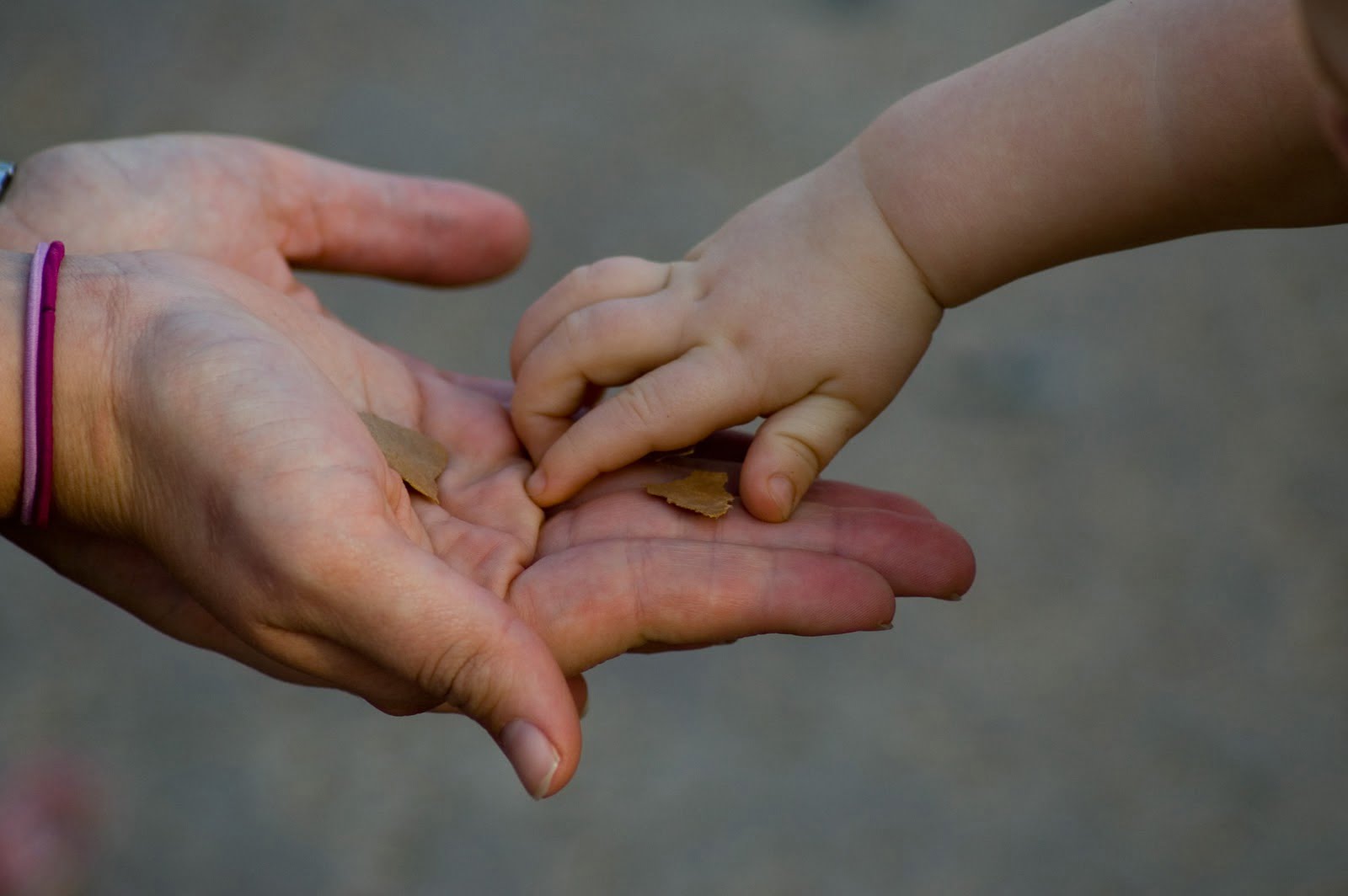 Because the Spirit moves in our world, we believe, right? And if we believe that the spirit moves then, what God wanted from us and what we spent so much time building in 1980 might not be what God wants from us in 2012. When we hold tighter onto tradition than we do Spirit we often have religion. When we hold tight to what the traditions of our religion offer us with room for the Spirit to shake us as needed, we have spirituality.
When it all boils down to it—James begs the church of his day and the church of our day to ask ourselves—are you spinning your wheels on building up what matters or are you just spinning your wheels?
Is your religion that of caring for orphans and widows i.e. those in need of compassionate justice in this world? Is your religion of following the teachings of Jesus or just debating them or pointing out how other Christians aren’t living into them? Is your religion that of building bigger buildings and structures that leave a mark of “we were once here?”
If so, then, James tells us to re-think our religion.
Anytime I do a funeral service, I find myself repeating a phrase of exhortation to the mourners—a phrase, I hope at least some of them might remember later because it asks them to channel the grief and loss of their loved one into well lived personal lives that bring glory to God. I guess I should get some new material but I can’t seem to find a better way to say it.
“When you and I die, only one thing matters: not how much money we have, not how many flowers decorate the alter, not how many people attend, not how many groups or societies we belonged to—only one thing—is it well with our souls? Are our lives in harmony with God? What will profit a man or woman if he or she gains the whole world and loses their own soul?”
So, this brings me to the place where I really want to say to those people who tell them they are too spiritual for church—I understand. I hear your frustrations. And you really want to find more God in your life and it just seems like a purer search to go at it on your own. I realize the church can be a messed up place. Institutions are like this. Sometimes we make good decisions that bring us together and other times we miss the mark painfully. And I consider myself a spiritual person too.
But, I also claim my religion as much as I claim my spirituality. I am a Christian. And with that comes the place called the church where generations of other believers before me have lived out their faith too. Is the church perfect? Has it made way more mistakes in its formation, declarations, and judgments than it has for the good of the world? Probably.
Yet, I won’t leave the church, though; it might be a lot easier in the short turn with a lot less meetings. Why? My faith is communal. It’s communal with the saints and sinners who have gone before me. It’s communal with the saints and sinners who fill the pages of my life right now. I believe the Christian journey, like that of the Jewish journey or the Muslim journey, is one at requires a lot more “we” than “I.” I need the church’s religion for my spirituality to have a home. It may not always be my only home, but it’s my home nonetheless.
So this morning, I’m asking you to consider again how much the spiritual but not religious among us are right—sometimes church we have our noses so deep in the sand that we forget the vastness of God that can only be found outside these four walls.
But our calling to be the church—to love each other, to love God and follow the teachings of Jesus together continues on, no matter who validates our togetherness or laughs at it while riding their boat or reading the paper on Sunday morning. Yet, knowing when our faith is lived out – being doers of the word, not just hearers only, it might just might look 100% different from any church we ever expected to be. So if you are with me on this, hang on to your seats and get ready, change is coming. It always does. It's just a part of our spiritual journey together.
May God continue to lead our church by the Spirit with courage to go wherever Jesus leads us.
AMEN
 You haven't seen me blog as much as I normally do lately other than posting sermons. Writing like a crazy woman some days, I've sought to give more attention to my book long project instead of other stuff.
When I come out of my writing cave and seek to tell people what I've been up to, the number one thing people say often in a condescending tone of voice is: "That must be so healing for you" or "Writing is so therapeutic, so good for you."
And in response, I use self-control to not growl. And I really want to growl.
I realize people mean well. They're just trying to be supportive. Many can't imagine writing as honestly as I am trying to do.
But, I want to proclaim writing is not an "all about me" task. It's not something I do rooted in selfish motives. I' m not trying to throw up my emotional baggage on the world. I write because I am a writer. I write about painful things sometimes because painful things have happened to me and need to be heard. I write about joy sometimes because happy things happen to me and I want to encourage others. I write because like a painter or a carver or a sculptor, word choice is my art form. I write to practice my art. Sometimes what I produce is good art. Other times it needs to be sent back to the drafting board altogether or thrown in the trash. But it's still art. And I still must write.
If I wrote for therapy, then I should get a journal or talk to a therapist (I already do both from time to time). These things are less painful. More private. Less drafting and wasted paper.
It's burdensome task, I believe, putting your honest self out to the world, having no idea how people will respond to a story that isn't just a story to you. It's your life, and the only one you've got. Writing about your own life, I believe, can be one of the most courageous things people do.
Sure, as they say, writing can mature the soul. In writing, the pain has somewhere to go: to the paper. And, when you have to think about something long enough to find just the right word, you usually walk away with heighten self-awareness (which is never a bad thing). Healing and self-awareness are cousins. It's true.
But I don't think most writers, write because of personal sickness (though I'm sure some do, but I'm not friends with these folks). I don't think writers write so that just anyone can know their less than flattering thoughts or moments. I don't know think they write just to feel better. Writers write to connect them into what it means to be human.
And this is my point: I write because I don't know how to not write. So if you stick around, you'll have more to read in the future. And, this is what I can promise you, the stories to come will be my truth.
In our consumer driven everything culture, we often treat reading as just another thing to conquer, to finish, to master. In seminary, we marked our progress by how many textbook were on our shelves. Colleagues ask me at conferences, "How many books have you read lately?" Congregants ask me: "What books can you teach us more about?" I've often fallen into the trap of reading just to be done with something or just to teach something. And then, that is it. I cast the book aside.
Not all words written down on a page are meant to be treasured (fluff beach reading, for example). However, sometimes words do hold lasting power. And just need us to pick them up again to find the gems.
I've found myself doing a lot of re-reading lately instead of picking up new texts. Books can be like old friends, coming back into our lives to provide comfort or simply reminding us who we are. And I think this is true of fiction and non-fiction alike.
 Several years ago, I picked up at a fall DC library book sale a copy of Renita J. Weems's memoir, Listening for God: A Minister's Journey Through Silence and Doubt. How surprized I was to find this book! Though I was not going through a season of doubt at the time, the title sucked me in. Seemed like an honest text (I'm always looking for these) worth the dollar price tag (what a steal!).
I was familar with the author's name. Weems, a preacher, scholar and formerly a professor at Vanderbilt University, also wrote, Battered Love which I read in my Women, Theology and the Church class at Duke Divinity.
That September, I remember speed reading through it, feeling so happy as if I'd found a long-lost soul sister. Weems, coming out of a conservative tradition that didn't necessarily affirm her gifts for ministry, writes about her struggle to stay connected to spiritual wisdom, even as her well ran dry and her faith shifted. After finishing it, I was quick to recommend it to friends (as I usually do when a treasure is found) and put it on my shelf again in the "has read section." I didn't touch it for years.
However, in picking it up again this summer, I've read slower. I've stopped myself to process some of her nuggets of truth in short chunks. I haven't rushed. And, yesterday, I came across this reflection about the meaning of dreams which was perfectly instructive to my life right now. I keep having the most vivid dreams in color and in details that I can actually recount in the morning. And, I hoped for some wisdom to begin to make sense of them. And so how perfect that Weems wrote:
Wherever dreams come from, and I don't pretend to know where that is, it's a place within each of us, down within our souls, a place that won't take no, shut up, not now, you again? for an answer. It's a place that demands our attention and resolves to get it, whether with laughter or terror. It's a place within which insists that we remember the lives we have lived, says Frederic Beuchner. It calls us to remember memories emotions, remember moments, remember things we've tried furiously to avoid or to forget. Dreams beckon us into a still room within us where it is safe to remember where our journeys have brought us. It's safe because it is safe because it's a place where we can face our fears, anger, and dread and see them for what they were and are: feelings that needn't last forever. It is safe because no one , God is has access to that room, save you and God. And there in that room filled with our greatest anxieties, God meets us and beckons, "Come, it is time to be healed."
Each time a dream has enough current in it to awaken us, God is speaking to us through some chamber within us, beckoning us to come in. It's time. It's time to remember. It's time to lighten up. It's time to sort through. It's time to heal. It's time to let go. It's time to learn how to laugh at ourselves.
Thank you Renita Weems. I'm thinking more about some recent dreams of mine as I ponder your words, hoping that as you say they might lead to more healing in me and others too.
You see, sometimes, reading can be the gift that keeps on giving.
Hear more about the passion and excitement my husband Kevin has about his new job. It's more than a job-- it's a ministry and it is great to watch him shine! I am so proud.
http://www.youtube.com/watch?v=PUC7ZbWdgQ8&feature=youtu.be
We are currently preparing for our first trip with Feed the Children overseas-- leaving a week from Monday for Malawi and Kenya. We'll be visiting with schools, orphanages, and community leaders that are a part of the larger FTC family. I'm most excited about meeting the children and being able to love on them and find out more about what we can do to encourage them. Best of all, this trip is something that Kevin and I will do together.
If you are interested in learning more about Feed the Children or how you can give to support this great work: click here.
Yesterday, we held our second deacon ordination service in the tenure that I've been pastor here. It was a great celebration service to welcome Marie 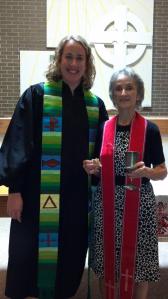 Mercer onto the deacon ministry team, and a good opportunity for us as a congregation to remember why it is that we call servant leaders out in our churches. When we held our first deacon ordination service (in over 20 years!) in November 2010, the church body as a whole was a bit skeptical, I believe of this type of ordained leadership but I think what the congregation has experienced since is delightful surprise. We are blessed by our deacons at WPBC!
Acts 6:1-9: Deacons Needed!
There's nothing like a good church fight to get God's plans for a community moving in the right direction, isn't there? Well such was the case as we look into our Acts lection for this morning. The beginning of the first deacon ministry came out of a church fight.
Though when many of us think of the title of deacon, nice and hallowed images come to mind of saintly folks who serve in leadership positions in churches, the role of deacon within the church community evolved out of a conflicted situation that only some attention to administration could fix.
The church, as it began, was centrally located in Jerusalem and new believers to the family of faith emerged almost daily. Everyone shared their possessions with one another. Powerful healing and teaching regularly existed as part of daily life. Yet, found itself at a moment of crisis: not everyone got from the community what they most needed.
When communities of faith are filled with diverse people, we know that conflict is inevitable. And, the community of believers in Jerusalem had never been homogenous from the start. Remember that the day of Pentecost occurred on a day, afterall when faith Jesus gathered from all parts of the known world at the time, speaking more languages than just one. In summary, some members of the community spoke Greek, others Aramaic. Natural barriers led to patterns of poor communication, mismanaged expectations, and unspoken resentments. Specifically, the widows who lived outside the city center of Jerusalem felt they weren't receiving the same treatment as those who lived closest the 12 apostles.
And so the murmurings of complaints became so loud that a church hall meeting was necessary. What were the apostles going to do to fix this problem? The crowd of believers demanded to know.
Together, they discerned the answer: the birth of the diaconate: a group of selected, training and ordained believers who felt a call by God to the service tasks of the community including but not limited to: caring for the often neglected widows, orphans, the powerless, the destitute. And though the word "deacon is not specifically mentioned within this text, it is a word used in other places in scripture. Deacon comes from the Greek word diakonos which means servant or helper.
For what was going on in Acts 6 was THE development of how Jesus-centered community life could flourish in the long-term. It was about an organization with an "ineffective infrastructure" that needed rebuilding before it could move forward to the next level of God's best for it. And this was the discernment process: would the church be ruled by a few with assumed superpowers to do EVERYTHING or would the church be a place where gifts of service of ALL people could be celebrated and utilized for the community's edification?
Depending on what church background we were raised in or experienced before coming to this church, we might not be on the same page with the word, "deacon."
If we came from high church traditions, like found within the Catholic church, we might imagine deacons as those who serve in official capacities under the ordained priests-- preaching assisting with communion preparation, wearing vestments, etc. Deacons often as those who are set aside as a "pre-cursor" to the ordination of the priesthood, a position which is set above the congregation in terms of personal calling and expectations of spiritual leadership.
If we came from traditions within mainstream Protestant life, deacons are often present within the fellowship of the church, but you often don't know they are even there! The care for members of the congregation when special needs arise. Many times, deacons receive theological education in form of a seminary degree or attending a lay leader institute. They are often ordained, but never for administrative tasks-- only for service.
If you grew up as I did in a traditional, low church tradition, you experienced a deacon in more of an elder role-- serving as an administrative leader alongside the pastor (often hiring and firing the pastor!). In this context, sometimes deacons are asked to administer the caring ministries of the church, but most famously the deacons are those who emerge in all their glory on the day when the Lord's supper is served. Deacons in churches like these are only allowed to serve communion to the congregation, a long with their pastor.
While I celebrate the diversity of church tradition and interpretation of this scripture text, what REALLY were the first deacons asked to do?
Despite all of the modern-day confusion, the first deacons, as we can tell weren't asked to sit on the church council or serve as protective lawyers of the church's assets.
The first deacons weren't asked to make theological statements of doctrine about who was in the community and who was out.
The first deacons weren't asked to pick out what color the altar table would be or if they'd sit in comfortable pews or hard ones.
The first deacons weren't asked to be scholars in theology before beginning their time of service.
And most certainly, the first deacons weren't given special clothes to wear.
The simple answer is that deacons were asked to serve. They assisted the apostles so that they could get back to the preaching, teaching and healing ministries of the church and not get bogged down in who did or didn't get enough rice that month.
What were the qualifications of these persons. Deacons were to be of good standing in the community, full of the Spirit and of wisdom.
Notice what part I left out-- the qualification of gender. While the cultural practice of a particular time and place revered men only, a better interpretation of this text for our time readers, "select for yourselves seven individuals").
In a nutshell, deacons were to be the persons who lived their life in such a way that their sound character shone through first. And so today, it is our honor to ordain this one whom our deacon body has called out for service, Marie.
Our prayer for her this day and for all of us who will benefit from her ministry in this church is that through her service, more of us might come to know Jesus more.
All of us are given, as followers of Jesus, a calling of service. To some of us we may not be deacons, but there will be other talents God wants us to use in this place too. May we take a few moments as we watch and observe the laying on of hands of blessing for Marie-- that God has called each of us to both serve and be served. This is the BEAUTY in the body of Christ!
Thanks be to God.
AMEN
