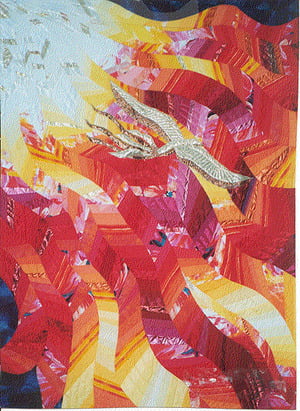
Washington Plaza folks, remember to wear RED on Sunday as we celebrate the coming of the Holy Spirit and the birth of the church-- a great festivial day in the church year!
Several of you have asked me recently: what is Pentecost?
Courteousy of a online Christian site, here is a good place to start the conversation:
Pentecost is the great festival that marks the birth of the Christian church by the power of the Holy Spirit. Pentecost means "fiftieth day" and is celebrated fifty days after Easter.
Ten days after Jesus ascended into heaven, the twelve apostles, Jesus' mother and family, and many other of His disciples gathered together in Jerusalem for the Jewish harvest festival that was celebrated on the fiftieth day of Passover. While they were indoors praying, a sound like that of a rushing wind filled the house and tongues of fire descended and rested over each of their heads. This was the outpouring of the Holy Spirit on human flesh promised by God through the prophet Joel (Joel 2:28-29). The disciples were suddenly empowered to proclaim the gospel of the risen Christ. They went out into the streets of Jerusalem and began preaching to the crowds gathered for the festival. Not only did the disciples preach with boldness and vigor, but by a miracle of the Holy Spirit they spoke in the native languages of the people present, many who had come from all corners of the Roman Empire. This created a sensation. The apostle Peter seized the moment and addressed the crowd, preaching to them about Jesus' death and resurrection for the forgiveness of sins. The result was that about three thousand converts were baptized that day. (You can read the Biblical account of Pentecost in Acts 2:1-41).
Red is the liturgical color for this day. Red recalls the tongues of flame in which the Holy Spirit descended on the first Pentecost. The color red also reminds us of the blood of the martyrs. These are the believers of every generation who by the power of the Holy Spirit hold firm to the true faith even at the cost of their lives.
WHAT IS THE SEASON AFTER PENTECOST?
Because Pentecost is the day that God poured out His Holy Spirit on Christ's disciples, the Season after Pentecost is centered on sanctification, the work of the Holy Spirit in the day to day life of the Christian. This is reflected in the liturgical color for this season: green, the color of life and growth. Through the gift of faith that comes only from the Holy Spirit, Christians are enabled to trust in Christ and proclaim Him in their daily lives by service to their neighbors. The season after Pentecost is the longest season of the church year -- it lasts from Trinity Sunday [which we will celebrate on June 7th] until the first Sunday of Advent. This is the non-festival portion of the liturgical calendar during which the church stresses vocation, evangelism, missions, stewardship, and other works of mercy and charity as ways in which Christ empowers us by His grace to share the Gospel.
There are three "mega-festivals" commemorated in the Christian calendar. The first two, Christmas and Easter, are well known to both believers and non-believers. But it's possible that even liturgical Christians may not be as familiar with the third, the festival of Pentecost. This precious gift of faith in the saving work of our Lord Jesus Christ is the reason Pentecost is the third "mega-festival" of the church and why we celebrate it with such joy and thanksgiving.
 Such was the request of the Women's group a couple months ago. The leadership of this group of women that meet twice a month asked me to come lead a couple of sessions about what it means to pray. Some of them had expressed that they weren't sure how they prayed or how it was that they invited God into their daily lives.
These are the best kind of requests to get as a pastor. They make you happy about your job. You know that people care about the growth in their own spiritual lives and are seeking out resources to make this growth possible.
Not that I am an end all expert on prayer, but I agreed to lead the session because I wanted to honor the desire of this group to become more comfortable with the topic of prayer.
I used one of my favorite books: The Quotidian Mysteries: Laundry, Liturgy and "Women's Work" by Kathleen Norris as resource to begin the discussion.
I think often times we as people of faith, people who want to connect with God make prayer harder than it is. There is a lot of pressure associated with the content of public prayer. We often stray from prayer because we think that God has strayed from us.
Yet, the encouragement that I sought to share with the group was that prayer can be a part of the whole of our lives- the mindfulness which we carry out our most daily of tasks. Prayer is not as hard as it seems. And, in prayer, we can be brought back to our center when we begin to lose our way.
Norris writes this: "Saint Tersea of Lisisux said in her autobiography, Story of a Soul that Christ was most present to her not “during my hours of prayer . . . but rather in the midst of my DAILY occupations.”
It is in this spirit of mindfulness that we find prayer to become a part of all that we are, not just something we have to sit down and require ourselves to do for certain period of time. Norris like to talk about how the routines that many of us consider "boring" are in fact the very things that can bring us closer to God.
Kathleen Norris writes: “Shampooing the hair, washing the body, brushing the teeth, drinking enough water, taking a daily vitamin, going for a walk, as simple as they seem are acts of self respect . . .. Care asserts that as difficult and painful as life can be, it is worth something to be in the present, alive, doing one’s daily little bit.”
So that in the ways we care for our bodies, attend in kindness to our schedules, and make time for daily tasks like laundry, dishes and exercise we are praying. We are saying to God: "I honor the body and the life that you've given me. And, I will take time not to be so busy that I don't recognize where you are seeking to be known to me in my daily activities."
Session two on prayer will include more prescribed ideas about prayer from scripture, but for this week, the idea I wanted to convey about prayer is that the practice is closer and more accessible to us than we might think. It is something that we can all do.
Today at Washington Plaza, we celebrated a service of baptism for two adults who have joined the church in the last several months. I was an exciting day on many levels for all of us. I walked into Sunday School this morning to find the usual crowd quite giddy with energy. We were all happy for Steve and Barbara.
Several folks asked if this was the first time that I had baptized anyone. The answer was no. Especially in the second year that I served at First Baptist Church of Gaithersburg, I was often in the pool. To my best count, after today, I've now baptized 10 persons.
Baptism in the Baptist tradition is done by immersion instead of sprinkling babies (as most other churches do). While I have great respect for parents who seek to baptize their children as infants (and believe it "counts" as baptism-- immersion is not the only way), Baptists wait to baptize folks until they are able to confess faith for themselves. Often times this happens to older children, youth and even adults.
For the pastor doing the baptizing this week, it is a "full body" experience as well. You actually get in the pool (either found in the sanctuary or at another location like a river if the church is not built with a pool) with the candidate and guide them under the water. However, going to a Methodist seminary, I did not get baptism lessons when I studied there . . .
So, when time came for my first baptism back in February of 2007, I knew I needed to practice especially as the first person I baptized was a very tall man originally from Chad, AFRICA. So, our friend, Jeff volunteered being about the same size to "practice" with me one afternoon at the church. Jeff, as a devote Catholic found the whole experience very educational. He'd never seen a pool in a church before, calling it at first "Sea World Over Jesus." Jeff was a good sport, patient with my inability to get him under the water until we tried probably over 20 times. Baptism is harder than it looks! (But, secretly I think he was trying very hard not to go all the way under . . . )
Kevin recorded the hilarous event and just for a joke Jeff later posted it on You Tube. To all our surprize, "Baptist Baptism Gone Bad" was a big You Tube hit. Actually it sparked a long debate in the comment section about the authority of women to be pastors. Read it for yourself. Kevin, Jeff and I are still shocked about some of the things that people said.
Here is your pastor's first attempt at baptizing, laughter and all:
[youtube=http://www.youtube.com/watch?v=m0nIlpMs4D0]
We've been working hard to network virtually over the past several weeks. Though I may wish that our neighbors would come to worship on Sunday mornings to get to know us personally, often times these days people know us through what we say about ourselves online. Updated, easy to follow websites are the first impression that you don't want to mess up.
I'm excited about the progress that has been made recently on our church's website. Check it out here. Deb, our church administrator works hard to make sure the information on our site is kept up to date, showing any who might be interested in worshiping with us that we are alive and well. There are still changes to be made in the future, but the progress so far as be huge! (Thanks, Deb!)
Also, there are several folks from around the area and the country who are choosing to follow what we as a church are up to through this blog.
I want to give a shout out to several of them who have listed us on their blog roll:
GoReston.com: a site that follows community life and trends has listed Preacher on the Plaza among their blogs. (Really exciting that they would include a pastor!)
A site of Baptist bloggers, recently invited me to join. It includes folks from all across the theological spectrum. I was told I was the first woman pastor they've listed thus far (though I know there are tons of you out there if you want to get in on the list).
My friend, Theresa Thames-Lynch, who is ministering to children and families at Foundry United Methodist is following our progress. She attended the installation service and wrote about it here.
As well, as another seminary friend of mine who is also a blogger, Maria, who is working on an advance degree at William and Mary and also very involved in the Episcopal church. She writes with such wisdom about life which is always encouraging.
And, recently, I got notice that an associate pastor in Massachusetts, who I haven't met is following us too.
I say all of this as a means to inspire excitement in Washington Plaza folks for the new things we are engaging in as a church. Technology does matter. The more we can connect with our neighbors and those in ministry alongside of us the better!
If you are following us with a blog of your own that I don't know about, feel free to leave information about it in the comments. We'd be glad to know who you are out there in cyberspace. Thanks for sharing this journey with us.
It seems in our work-a-holic culture talking about taking time off or leaving the office at a reasonable hour or using all of your vacation is taboo. And, such ideas, I believe extend into the church. Pastors, especially are praised for being at every last event and meeting, working overtime and not taking their vacation time. It is as if more work= assurance of worth. And, I seem to be having conversations all the time lately with my pastor friends about how taking time off is rarely modeled to them by mentors and supervisors in postive ways.
As I grow into my professional role, I am hoping that there is another way for us to be. We need Sabbath. And, it may or may not come on Sunday. (This is why pastors take off another day of the week).
I need to take my days off (which I've decided to change to Thursdays). I need my vacation. And, I need to allow God's rest to come to me in regular periods. It is not being lazy. It is not neglecting God's church. It is part of who God made me to be that I just can't ignore.
I like to work though, so Sabbath is not always the easiest practice for me to live into. While I always have chunks of time off here and there in every week, there is a difference between a day off and an hour or two off mixed in with work. It just isn't the same if you don't get a full day.
In my new role of being the only pastor around, there are always needs. I'm never "off" call. There are always phone calls to return and emails to write. It is really easy for work to invade your family time if you allow it too.
But, this week, I took a day off. It was the first time that I felt like I'd taken a real day of rest since I got snowed in on a Monday back in March. Actually, I took more like 40 straight hours off and it was wonderful. I forgot what the breathing space of time off really felt like. I forgot how nice it is was to not to feel like there was something I had to do except enjoy the day at the day's own rhythms. I ate good meals. I shared good conversation with some dear friends. I took a long hike in the woods without cell phone reception.
And, I returned to work happy to get back at everything on my plate. You don't feel as productive being gone, but in the end, it has all been well. While it is annoying that often we have to work harder to be able to rest and then work harder as a result of taking rest, I think we have to continually remind ourselves to practice Sabbath anyway. It is one great reminder that we aren't in charge of the universe afterall. The world will go on without us.
God's deep rest is what feeds our tired souls. Turn off the cell phone. Unplug the computer and the tv and experience Sabbath sometime soon. I know you will be glad you did.
I am using this Thomas Merton prayer in my sermon this morning. We are examining the topic of discernment and how God might be calling us as a congregation to engage it as a spiritual practice. It has been a favorite of mine for years and it seems like just the perfect opportunity to share it with the congregation. There is so much about life is unknown even when we think we are doing the "right" thing. I believe this is where the blessed gift of God's providence comes in to make all things right in God's time.
I thought I'd share it with you today in case you weren't in church to hear it:
My Lord God, I have no idea where I am going. I do not see the road ahead of me.
I cannot know for certain where it will end.
Nor do I really know myself, and the fact that I think that I am following your will does not mean that I am actually doing so.
But I believe that the desire to please you does in fact please you.
And I hope I have that desire in all that I am doing.
I hope that I will never do anything apart from that desire.
And I know that if I do this you will lead me by the right road though I may know nothing about it. Therefore will I trust you always though I may seem to be lost and in the shadow of death.
I will not fear, for you are ever with me, and you will never leave me to face my perils alone.
AMEN
I recieved this in an email from a church member this week, Mary. A thought worth pondering. . . .
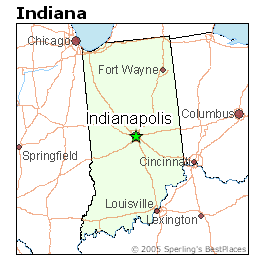 Last week, I asked to attend the Transition in Ministry Conference in Indianapolis representing the Lewis Fellows program with three other of my colleagues. It was a gathering of around 125 other younger clergy, all representing different transitions into ministry programs funded through the Lilly Foundation.
It felt like a honor to be among even more really energetic and passionate clergy of all different denominations from across the country. It seems that such opportunities just seem to fall into my lap and I am very grateful for this. I always walk away thankful for the chance to have my network of peers expanded and get new ideas about what others are doing. I often find myself feeling more at home in ecumenical settings, rather than in Baptist only groups too.
One of the most meaningful parts of the conference for me was hearing the group sing together. Only but a few of the group were trained musicans, but the harmonies we created everytime we sung were amazing. Not that all pastors can sing-- I sat beside many who can't hold a tune. So, I believe this is what shocked me.
Our practice was to sing the Doxology before every meal-- all in our own words based on our traditions. The words out of every mouth were not always the same. Some said Creator, Sustainer, and Holy Ghost. Some said "He" for God and others used the more inclusive "God" instead of "He." Some used the traditional words "Father, Son and Holy Ghost." Yet, it didn't really matter. It was a beatiful nonetheless.
I believe this is what the future of the church is about. Diversity at its best. Voices with different words coming together in common purpose. Harmony in spite of training or no training at all. Acceptance of other's gifts and theology.
I am glad to be at home and back to "normal" life this week (I think you work twice as hard while at conferences trying to do the conference work and keep up with everything else at home remotely at the same time), yet also inspired to life out the future of my wonderful little church here in Reston.
Though it is a joyous day of celebration for many, Mother's Day can be awkward in churches. I have heard countless horror stories of how something a pastor said on Mother's Day scarred a woman for life. I've heard some really bad sermons of what it means to be a "good woman" that should never be a subject of a sermon, ever. And, I know the pain of loss for those who no longer have their mothers on earth can be very sad.
At Washington Plaza, my hope is that we can acknowledge this cultural day, but reclaim some notions of it too from life in the Kingdom of God where love is always exalted and community relations of all kinds are encouraged.
I came across this litany this week and am choosing to include it in our service tomorrow. I love the inclusive nature of the words-- a real celebration of all women and the roles they play in all of our lives no matter the situation. I thought I'd include a portion of it as a Mother's Day prayer for those of you who might not be with us tomorrow in worship.
Mothers come in many different forms, and today we celebrate them all! Thank God for mothers!
For those women who have joined God in Heaven and whom we miss dearly here on earth.
Thank God for the mothers of the past.For every woman who is working day and night to raise her children right now.
Thank God for the mothers of today.For the women who took in others' children through adoption and foster care.
Thank God for the mothers with hearts so big.For those women who have lost a child to death and must carry on.
Thank God for the mothers who are so strong.For all the women who have desperately wanted to have children of their own, but chose instead to mother everyone else.
Thank God for the mothers in spirit.We thank you, Lord, for the women who have influenced our lives in so many ways. We pray that we will honor them in everything we do. Amen.
One of the reasons that I keep saying that I'm proud to be the Pastor of Washington Plaza and will continue to say this is because of how intentional it is with its community life. It is a group of people gathered on Sundays and at other times that actually know each other.
I've been to churches where I've walked in and walked out and no one has spoken to me. I've been a member of churches where I attended for years and there were still people who I sat alongside in the pews who still thought I was a first time guest.
I dare say that such statements are not true at Washington Plaza.
Yet, as we continue to be about the work of strengthening our community life, I know we will find that the work will grow harder and harder. Community, the kind where you know me and I know you can be anti what our natural human and cult ural tendencies are.
I was encouraged this week through reading a book called New Monasticism: What it Has to Say to Today's Church by one of my seminary classmates, Jonathan Wilson-Hartgrove. Though our church community has not made the choice to live in intentional Christian community like Jonathan and the others at the Rutba House in Durham, NC have, we still are seeking to live together as a church family.
I thought this passage might be particularly helpful to thinking more about what we are doing. Jonathan writes:
Best I can figure, community is a lot like a garden. Somehow there's always work to be done-- dishes to wash, meetings to go to, prayers to pray, meetings to go to, laundry to wash, meetings to go to, meals to prepare . . . and more meetings to go to. After you've sat through a few hundred meetings and heard the same people say more or less the same things over and over again, you are tempted to think, 'I know what this community needs. If they would just listen to me, we could get with more important things.' But it never works. Because, as with a garden, you can't make community grow. All you can do is tend to a culture of grace and truth by listening to every voice, loving people who frustrate you, telling the truth as best you can, and doing the dishes.
The great temptation in community life is to imagine that our life together is not like a garden but like a repair shop. . . . They figure out what is wrong, get the parts they need, tinker around under the hood and fix it. . . . Now I have to tell the truth: it doesn't take long in community to realize that people are broken and in need of repair. And the minute you realize this, you're liable to think, 'I can name this person's problem better than they can. Maybe I can fix her.' You do this because you love her, of course and want her to be better. . . . The problem is that people aren't like cars. We aren't made to run just fine on our own. And the repair shop won't do, because we were made for life in a garden. And the only way to grow up into life in a garden is to get into your roots and stay there."
And to this I say, Amen. Let's us all continue to work together in the garden.
We live in such a strange world these days. Relationships as our grandparents or even parents knew it just no longer exist. No longer are friendships based on communication via letter, phone calls or in person visiting, but rather worlds of online and cellular networking called Twitter, Facebook, texting and email.
And it is not just youth or even young adults who are living into the latest trends, but older adults too. It seems the number of "friend" requests I get for Facebook from persons over 50 is growing by the day.
I don't mean to bring up this topic to sound like a anti-technology person. I've always loved any form of communication and I have tried to fully embraced the latest trends (minus getting email on my cell phone which I simply refuse to do for boundaries reasons). I think it great for my world of acquaintances, family and friends to be more in touch with one another's lives on a regular basis. Hey, this is one of the reasons, among many others, that I blog with such consistency!
But, what concerns me is that seemingly more and more of my friendships are based online communication only. I meet up with persons whom I haven't seen for a while and learn they know more about me than I've ever thought they knew from reading up on my online postings: my twitters, my facebook status or my blogs.
The problem with this is that without seeing your face and you seeing mine, or without hearing your voice and you hearing mine or at least without seeing your handwritting and you seeing mine, we miss a level of connection that is lost in blog comments, facebook wall posts and twitter direct replies. What we miss out on together is the opportunity to listen well, recongize our true intentions and motivations, and I think also the chance to be truly friends instead of just the Facebook kind.
For these reasons, I am more thankful for the persons who surround my daily life through their physical presence. I am thankful that my days always begin in conversations with my husband Kevin. I am thankful that I spend time chatting with Deb, the Church Administrator (and usually Ernie, the Chair of Trustees, too) during my mornings in the office. I am thankful for the persons who choose to make appointments with me to talk over something instead of emailing only. I am thankful for friends of mine who take time out of their busy lives to share a meal and time for unhurried catching up. I am thankful for our weekends that are usually spent in conversations over dinner and activities with our church and community friends. All of these in person events are blessings I think I cherish more often now. Such moments are no longer the norm, they are modern-day gifts!
While I embrace the online world of communication and pastoring, I am happy that the real world in which I move and breathe still has persons in it that I can see, hear and embrace. While it seems that our online connectness continues to grow and bring us closer together in some ways, I will remain committed to communication the old fashion way too. Ultimately, I believe that real friends, in-person friends are the better kind to have and the kind that the church needs more of too.
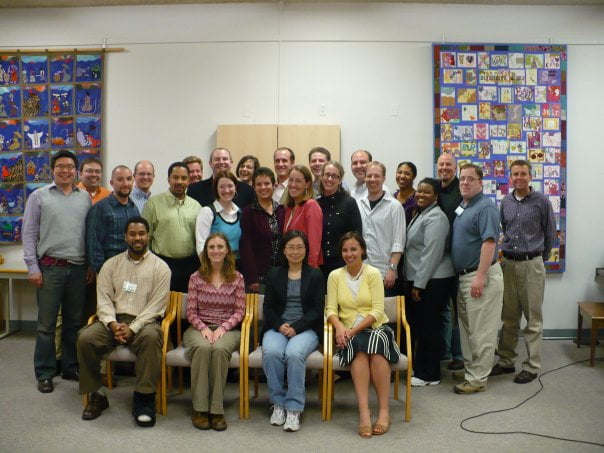
This will be my last post about my Lewis Fellows Cohort. I know I've written about it a lot. Yet, someone in the group just sent out this picture and it made me happy. I just had to post it.
It was taken at our "graduation" from the program at Wesley Seminary last Thursday night.
The church is in good hands with these wonderful colleagues of mine in leadership positions of the church. I'm excited to follow the careers of my peers as I see the great things they do to help the church live more fully into its calling.