 I have found myself this week saying, "Elizabeth, you need to take your own advice."
The past several weeks of life have brought a lot of no's.
A lot of "I'm sorry you're not the one."
A lot of conversations that have made me question how I spent my time.
And a lot of wondering if I'm on the right path of non-traditional pastoring and writing? Or is there something else? How could I better financially support my family?
And if I'm being honest, I'm at the point where I'm not dealing with the uncertainty well. My bank account looks afraid for what is to come too.
So, in fear of what is not, I've robbed myself of joy in the present. And I'm certainly not living up to my words for the year: "let worries go."
But here's the thing: I published a book about all of these feelings. Though people say I wrote about infertility, it's really not a book about infertility.
It's a story of setting out with  a dream but life not turning out as I expected. It's a story about hitting rock bottom yet finding your way to still go on living. It's a faith story of how unanswered questions and fears for worst case scenarios become pieces of a tapestry of growth. It's a story that's mine and it's a story that is yours too.
So bottom line: I've been here before.
I recently told a friend who asked me what I thought Birthed was about: "It's about life being more beautiful than you ever thought possible if you wade through the suffering."
Bingo. It's time for me to believe in my own book's message again.
Life can be good, in fact very good on the other side of the unknown. I've seen amazing opportunities come out of nowhere at the most unexpected time. I believe faith is not faith unless it's tested. So here I am trying to remember. Trying to be full of faith. Trying to take my own advice.
Anne Lamott in her book, Three Essential Prayers: Help, Thanks, Wow (a great read by the way) says this about life's hard patches:
"Grace can be the experience of a second wind, when even though what you want is clarity and resolution, what you get is stamina and poignancy and the strength to hang on.”
This morning I prayed for an extra portion of grace in my coffee cup. And I'm praying that for you. Stamina. Poignancy. And the strength to hang on.
Something is coming. Something better on the other side. I just have to hang on to see it. You do too.
What's your advice for you?
There's a popular misconception when it comes to advice we give and crave during difficult times.
"You'll get through this. You can do it!"
"If I can survive this . . . I can do anything."
In life's hard places, we rally ourselves around images of strength and courage.
One of my personal favorites is the image pictured to the right. I mean, who isn't inspired by Rosie?
And while it is true: sometimes we need to just bear down and get through life. Something this is all we have the energy for. We live to see another day (and this is good!)
But is this the summation of life? Survival?

Life is not something we accomplish by checking off boxes at different stages.
Life is about living into abundance.
My faith tradition calls to mind the words of Jesus who said in John's gospel, "I have come that [we] might have life and that [we] might have it more abundantly."
But now that I've said this, I bet several of you might be wondering if I've now gone off the deep end of a gospel of prosperity. Just become a better person and you'll have more . . .
Ok, gag. No. None of that Joel Osteen nonsense.
But this: the deep suffering of our lives illuminates a path to abundance. For as we walk conscientiously through life NOT with a "I can't wait till this is over" but rather with a "What can I learn from this experience?" attitude, we change.
Two years ago this month, I found myself in one pretty difficult season.
Here are some of the highlights. I was-
I have to admit in moments of August 2013, "survival" was often at the tip of my tongue. (And some whining too). I couldn't wait for this and that to get better and life to return to "normal."
Instead, I could be re-made.
I could see the world and my vocation differently.
I could claim life as good even when it wasn't from all outside appearances.
I could gaze upon God in places full of such unexpected joy.
I bore new scars, yes.
I could tell new stories of horrors, yes.
And, I would probably always move through life with deeper caution, yes.
As I look back on all the terrors of that summer and where I stand today, I can honestly say I am grateful.
I'm grateful not just because I survived. Or I passed the test. Or because my body healed. Or however you want to describe it.
My heart softened toward those who faced unexpected medical illnesses.
My vocation found clarity and re-definition in ways that felt more like "me" all along.
My soul could hang on to the good when showed up at my door, no matter if it came from one person or a hundred.
Now, I can't wait to see what gift of abundance come next through all the ups and downs of my newest life chapter.
This is what I know: you and I are living in a human community of rich provisions.
Let us stop just making it to another day. Or checking the hard stuff off our list. Such survival will get us nowhere interesting.

But let us claim the good and thrive! Let us live in this hard but beautiful world God has given us. There are so many wonders to behold!
 It's the week of Mother's Day. And it's that time of year that the church struggles to know what to do with women who aren't mothers in the traditional sense.
Pastors muse about, "Who gets a rose and who doesn't?"
The church ladies are known to whisper: "What should we do since ___ doesn't have kids?"
And, women without children can't imagine feeling safe in worship services.
I recently did this interview over at Amateur Nester's blog with two other pastors about expanding the conversation between infertility and the church. I wanted to share it again here because I think these words might be helpful to all of us struggling to be more sensitive to those who find this Sunday to be a very hard day. If you'd like to see the full post, you can read it over here.
EH: I [struggled] too. You are not alone. To live in a very fertile world and to have the desire to parent (which is a natural God-given desire) and then not be able to without a road of intense hardship is difficult. It is very easy to feel like God has abandoned you or forgot you. Or loves your pregnant friends more than you.
Don’t beat yourself up about these feelings. Be honest about them. Share your faith struggles with somebody who can handle them (and not everybody can!). Stay close to people who are dealing with pain, especially older women. Let them be your teachers even if they have never been through infertility or child loss themselves. Talk about suffering with them. Read the book of Job, even together. Let God be with you in the pain to the degree that this is possible for you. For, this will be your way out.
EH: Stay at home. Do something makes you feel good about yourself.
Last Mother’s Day, I was in between churches so I didn’t have to attend. Instead of going to services, I went to a class at the gym, ate lunch with a good friend and then took myself shopping for a Mother’s Day gift.
EH: When people ask me why I don’t have children, I tell them. Or in small groups of women if this is something that comes up, I share. But if they don’t, this isn’t something I keep to myself. If I’m a crying mess about my own heartbreak, I’m not doing my job as a pastor which is to shepherd and lead others.
I don’t believe it is the role of a pastor to “throw up” their struggles on the congregation. Rather, this is what counselors, friends and family members are for. In being a pastor that doesn’t share the ins-and-outs of my infertility with the congregations I’ve served, it has given me an outlet to remember that I’m not as much of a failure as my body makes me feel.
This does not mean that my own struggles with infertility and child loss have not enriched and informed my own preaching and teaching. For example, over the years, I’ve preached during Advent while going through IVF. I’ve lead a baby funeral after just having my own miscarriage. I’ve even preached on Easter when I was convinced God didn’t love me. These experiences have helped me be more in tune with where most people in the church are at one point or another: unsure of God’s presence and fighting to have some kind of faith. I believe my struggles with infertility have benefited my congregations, even if they didn’t know the specific reason.
EH: The church can stop saying stupid stuff like, “Everything happens for a reason” or “If you just pray harder. . . “ or “In God’s time . . .” These clichés are of no help to infertile women, or anyone going through a time of intense suffering for that matter.
Pastors need to do a better job of creating a climate of authenticity in church life. I mean, everybody is going through something. It could be infertility. It could be something loss of a loved one. It could be anything. We need to be able to talk to each other and abide with each other through the good times and the bad. Pastors set the tone for this kind of communal life.
EH: The resources I have to share deal with a theology of suffering.
One of my favorite books on this topic is Learning to Walk in the Dark by Barbara Brown Taylor. She has a lot of powerful things to say about how the “dark” times of life aren’t necessarily bad or full of God’s judgment on us, but rather an opportunity to more fully understand who God is!
I’m also a fan of Richard Lischer’s book, Stations of the Heart. Dr. Lischer was one of my professors in seminary and lost his son to cancer while his wife was pregnant with her first child. It’s one of the most real books I’ve ever read on grief and the forms it takes.
And Anne Lamott’s book, Stitches: A Handbook of Meaning, Hope and Repair is one of the best books I’ve read about what it means to walk with another person through suffering. Anne Lamott simply tells it like it is!
A sermon preached The Federated Church: Palm Sunday texts Genesis 4: 8-16
The title is a little shocking isn’t it? But hang with me for a minute and you’ll see where we are going.
Throughout Lent I've preached on lessons from the first family.
We’ve journeyed with Adam and Eve has they came into being as beloved children of God and as God made them caretakers of the earth.
We watched them make mistakes—hiding from God in the Garden of Eden. But then we saw God clothing them as a sign of God’s great love.
Then, last week we met Adam and Eve’s first two sons- Cain and Abel. One was a farmer and the other a herder. And when time came for each to bring their offerings to God, one brother brought the best and other just brought something. We saw in their story that we’re an angry people for all the many ways our lives have not gone as planned.
So, we conclude with the last first family story—reading rest of the tail of Cain and Abel— in conjunction with this high holy day in the Christian calendar: Palm Sunday, a day of great exclamatory praise, but a day that would ultimately be the catalyst for Jesus’ death. Which leads us to the question, what is it about us as human beings that would lead us to support or participate in the taking of another human life? Why would we as human beings want to kill our own?
 And the Cain and Abel saga gives us some guidance as to why.
Remember Cain was angry God liked Abel’s offering better. And even though God lovingly asks Cain to deal with his anger, he doesn’t.
Genesis 4:8 tells us this: “Now Cain said to his brother Abel, “Let’s go out to the field. While they were in the field, Cain attacked his brother Abel and killed him.”
In a plot I am sure worthy of any of the good crime shows on TV, Cain, being the more savvy of the brothers, finds a way to get his hated brother alone to a field. There he carries out a plot to rid the earth of Abel. How: we aren’t sure other than it works.
Abel dies.
Taking into account what we know about Cain and Abel previously we can assume it was because of pride . . .
It was because of jealousy….
It was because of anger . . .
And for what? So that Cain wouldn’t have to see his brother’s face anymore? So that Abel would not be a reminder of that great day of disappointment? So that Cain’s intense feelings eating inside of him would not eat him up any longer?
I guess, in the moment, yes. It was all about the short-term gain. An act of violence was an easy way out! Abel was a problem for Cain and the best way to get rid of the problem was murder.
Because this is who we are: murderers. We all make short-term decisions that steal from one other human dignity. We all find ways take life from one another, no matter if we kill another human being or not.
It's offensive, I know. I mean, isn’t murder one of those “on the shelf” sins from the Ten Commandments that most of us will get a free pass on? We can check it off our list because it hey, murder is something few of us do!
Well if we do any sort of close examination of the Bible, we realize that our most sacred text is full of the stories of characters we label as heroes but who also carry the description of “murderer.”
Moses, murdered a man who he saw mistreating a group of Hebrew slaves in Egypt before God called him out with the burning bush.
Joshua, Moses’ replacement certainly fit the battle of Jericho as the old spiritual goes, but then goes on to lead the genocide of the entire city.
Samson, one of the great judges of Israel who we might remember for his extra long hair killed 30 men with his bear hands and then 100 with a donkey bone.
Then, there’s David. (And who doesn’t like David?) The man who was called by the name of “a man after God’s own heart” killed Goliath as we all remember from Sunday School. But, he also killed and circumcised 200 men in order to get a wife he wanted.
Can I just stop a minute and say WOW!
Though we might think of people in modern times convicted of murder as somehow “other than.” The Bible reminds us that even the best of us are capable of the worst crimes against humanity. Just think of all the countries that have experienced genocide in our lifetime—Rwanda and Bosnia to name just two. Even the best of us can change our behavior very quickly. These shifts don’t make some people “bad” but simply among the tribe of human beings.
But, here’s the kicker for us all (who still think we’re off the hook this morning): Jesus’ teaching on the subject. During his ministry, Jesus reinterpreted the law on occasions like the Sermon on the Mount. Saying:
You have heard that it was said to those of ancient times, ‘You shall not murder’; and ‘whoever murders shall be liable to judgment.’ But I say to you that if you are angry with a brother or sister, you will be liable to judgment; and if you insult, a brother or sister, you will be liable to the council; and if you say, ‘You fool,’ you will be liable to the hell of fire.
Jesus give us this mandate: the label of “murderer” goes beyond the actual taking of someone’s life, but the intents of our hearts. No one is excluded from the label.
And furthermore, as Jesus’ life continued, living in the midst of such “murderers” was a human experience that Jesus knew full well. For he had seen people’s dispositions change very quickly during this time on earth. He’d seen the worse intentions of human hearts.
As we read our gospel lessons for this morning, we see an example of this dramatic shift by the crowds who say, “Hosanna! Blessed is the one who comes in the name of the Lord!” on Palm Sunday who by the end of the week shout: “Crucify Him! Crucify Him!” handing Jesus over to a cruel death on a Roman cross.
For there was something intolerable about Jesus too. During his time on earth, Jesus’ message was plain: all were welcome in the kingdom of God—the women, the sick, the lame, the demon possessed, the filfy rich, the dirt poor and everyone in between. And he said: the kingdom of God was about a movement of God bigger than who held the seats of power on the earth. It was about purity of heart and spirit and loving God and neighbor with a whole heart.
The people of his day were angry about all of this. They did not like the kind of people they were being ask to be!
For Jesus was NOT the king with banners and trumpets and overthrowing the governments as they wanted.
And, he was not one to be controlled or persuaded into anything other than the one send by God to be the good news.
Jesus frustrated the masses beyond belief!
 And the Jewish authorities couldn’t get Jesus out of Jesus what they wanted either, so they sent Jesus to Pilate—the Roman authority to figure him out.
It was Pilate who asked: “Are you the King of the Jews?” To which Jesus said, “You say so.”
We all know how the story ends. In the case of Jesus, it was easier for Pilate, the religious authorities and the crowds to say: “Let this man go. . . . Let us be done with him” than it was to deal with the truth of all that Jesus brought.
This is what I know for sure the story of the last week of Jesus’ life was not a freak occurrence: you and I, if we had been there could have shouted those very worst things too.
We’ve all looked at our neighbor with contempt. We’ve not defended their dignity. We’ve let our anger fester and flourish in us about those we are called to love the most.
We’ve made God sad . . . just as I know was God’s countenance that day as the crowds shouted “Crucify Him! Crucify Him!”
But there’s grace—there’s always grace. God did not come down and breathe fire into Pilate’s palace and kill them all. God did not strike down the masses chanting for the release of another prisoner instead of Jesus. Nor, did God strike down Cain.
No, in grace, he marks Cain with a special symbol, we are told in Genesis 4:15 that will keep anyone from doing to him what he did to his brother. While there is punishment for his sin, it is not the end of his life. Cain remains in the land of the living.
And Jesus carries out the work of great love that he came to earth to do—despite of what others said about him and despite it that fact that he would soon breathe his last. Love’s redemptive work was done in his body as we will celebrate on Friday.
So my friends, who are we? Who are you?
Receive this truth: we are all murderers. But thanks to be to God—nothing, no nothing can keep us from God’s love—not even what we think is the worst upon worst possible sin.
AMEN
 Welcome to one of the darkest days of the whole year— for Christians that is—the day we wait with Jesus in the tomb.
It’s the day that no one visited the tomb of Jesus.
It’s the day when nothing happened in the gospel narrative.
As if Jesus’ cries from the cross of “My God, My God, why have you forsaken me?” were not hard enough to bear yesterday, today we sit with the reality of our Lord’s death.
And the fact that God’s son wasn't exempt from heart stopping suffering.
But, in most of our traditions, we have little room for Holy Saturday theology.
Though our Anglican friends often host Easter Vigils—the rest of us have no clue as to why we’d want to go to church on Thursday, Friday AND Saturday too. What really changes from Friday to Saturday after all?
Isn’t the Saturday before Easter all about egg hunts, food preparation and shopping for new Sunday shoes? (well maybe not shopping for shoes this year)
Not that there is anything wrong with these things (and I’m going to be making some deviled eggs today myself). But I believe if we have our eyes already so set on Sunday, we miss out on a important part of who we are as followers of Jesus.
Throughout our lives we will ALL face suffering that is so painful that we think it might kill us and then one day it actually will.
And if you’ve ever gotten to the point when the dreams you once hung your future upon are no more, you know Holy Saturday.
If you’ve ever woke up one morning to find that your child, your spouse or your best friend to whom your life was deeply connected was gone, you know Holy Saturday.
If you’ve ever wagered all your hope on one event going just as planned, only to find it blowing up in utter disaster, you know Holy Saturday.
Holy Saturday is accepting death.
Holy Saturday is embracing grief.
Pope Benedict XVI once said: “To be sure, it was not Easter Sunday but Holy Saturday, but, the more I reflect on it, the more this seems to be fitting for the nature of our human life: we are still awaiting Easter; we are not yet standing in the full light but walking toward it full of trust.”
So, my word for this Holy Saturday is...stand here.
Take in this day. Breathe in, breathe out.
And let us wait for Easter together—both on its date on the calendar to come tomorrow and all the resurrection moments to come.
Some of us are going to be in Holy Saturday for much longer than just one day. . .
Life.
It is always happening.
Sometimes it's great. Other times it is not.
 And today I am wondering about existing when things aren't well.
How do you go on when we are very aware that life’s broken edges cracked parts of you that might never be repaired?
How do you keep breathing when everything in you wants to lay down in surrender to what is lost?
How you have hope when life is never full of any guarantees?
Such are questions I’ve been thinking about a lot lately both for myself and those in whom I love that are experiencing suffering.
Getting out of bed. Putting on pants. Cooking at home. Making hopeful plans. Going to the gym. Calling a friend. Laughing when something is funny.
This is what not so well seasons of life are all about.
Making space for Grace to surprise.
Accepting conversation and loving embrace.
Appreciating the kindness, even small gestures.
Walking in the sunshine.
Bathing slowly.
Remembering the breath of life that is and has always been within.
When it is time to pray again, it will come.
When it is time to walk on a new path, it will be revealed.
When it is time to create, it will flow.
But when all is not well, it is good to accept it. It is good to surround yourself with people who don’t mind your crying. It is good to drink hot tea and pour a glass of wine later. It is good to wear fuzzy pajamas.
One day, Grace will help you move on. One day.
Until then, you know that there you are. Breathing in and breathing out.
 I Want to Know Christ
Philippians 3:7-11
Preached: August 11, 2013, Martin Luther King Christian Church, Reston, VA
I always knew when I was younger that one day I’d want to be married. I would want to have a life partner—someone in whom I could share in all of life’s most memorable moments with and one day grow old beside.
By my teenaged years, I had expectations on how this might happen—mostly coming from the stories I’d heard from how my parents met.
From the time that I was small, when my sister and I would ask my mom about how she met my dad, she’d tell us about the day that she stood in registration line on her first day at Belmont University in Nashville, TN. As she waited her turn to sign up for her classes, her last name was Duncan and my father to-be was Evans, so naturally they found themselves in the same line—the D-E’s. And there they struck up a conversation and the beginnings of a friendship that led to a marriage began.
So, I too thought if I wanted to get married, all I’d have to do was go to college. And there on the first week would I meet the man who would make me his Mrs.
I’d arrive at college and bam! I’d walk on campus and say “Hello fine young men!” And, he’d be there.
Well— you can imagine how great this “bright” plan of mine worked out!
I was shy at the time and really didn’t like going out of my comfort zone of who invited me to tag along with them. I saturated myself in an all-girlfriend kind of community—eating, studying and going to the movies with girlfriends, not boys. I guess it kept me out of trouble, but that was about it.
Even still, I thought without any work, effort or sacrifice Mr. Right would make himself known to me: the man I most wanted to know and marry one day. In my head, I imagined he’d just knock on my door one day, introduce himself, we’d date and then we could just get on with our really happy lives.
Yes, I said I wanted to be in a relationship. But, no, I didn’t try to get to know any new young men.
Well—you know how that went. I didn’t really date anyone for the next four years.
When many of us think of our relationship with Christ, we approach it in a similar way that I did with dating in college. We say that we want to grow.
We say that we want to have a relationship with Christ that is vibrant.
But, we get stuck.
We get stuck in a version of faith that closely models what we were taught in children’s Sunday School back in 2nd grade children’s church.
We get stuck on the faith we observed in our grandparents but never truly made our own.
We get stuck when the most difficult life situations find us—throwing in all our cards and say, “Well, there must not really be a God. Because if there was a God this bad situation would not be happening to me!”
We get stuck even though most all of us understand this basic truth:
To be a Christian is to what? Follow Christ.
But we equate knowing Christ with church membership—showing up regularly on Sundays.
We equate knowing Christ with having hope of eternal life—resting on the fact that we know where we’ll go one day when we die.
We equate knowing Christ with doing unto others as we would have it done unto us—being a good person because that is how Jesus showed us to live when he was on earth.
And, while all of this is well and good and there’s noting wrong with any of these things, faith of that depends only on these sort of things becomes a sideline only type of faith. Yes, we say with our lips that we are a Christian but there’s no movement in our lives toward the direction of who Jesus actually was.
We say we are following Jesus but our life looks nothing like His did.
The apostle Paul has a few words to share with us about this found in his letter to the Philippian church. It’s a book of Paul clearly laying his feelings about how much this congregation meant to him and what he wanted Christ to be in his life.
It’s a book that Paul wrote from jail—during what was most likely the end of his life, a time when we was saying the things that he most wanted to say.
In fact, scholars feel that the book of Philippians is in fact that the book the one they are most sure that Paul wrote by hand. Put simply, Philippians is Paul’s heart put to paper.
And within this context we hear the Apostle Paul say, “But whatever was to my profit, I now consider loss for the sake of Christ.” And then he goes on to say in verse 10: “I want to know Christ and the power of his resurrection and the fellowship of sharing in his suffering, becoming like him in his death.”
These are familiar words. If we’ve been around church awhile, we’ve heard them a lot. We may just gloss over them with our ears thinking we understand already what they mean. Following Jesus is about death and resurrection . . . Ok, preacher, I’ve got that.
But pause with me for a moment.
Paul is elevating the supremacy of Christ by saying “whatever was to his profit (as we know from his life story that he used to be a very righteous law-abiding Jew), he now considers loss for the sake of Christ.”
But not only this, Paul says that he wants to know Christ in two particular ways.
The first is that he wants to know the power of Christ’s resurrection. And the second, is that Paul wants the fellowship of sharing in his suffering.
(Have congregation REPEAT).
Do you hear what we just said?
Paul says to know Christ is not what most of us think knowing Christ is about.
I heard nothing about joining a church. I heard nothing about having correct theology. I heard nothing about reading the Bible and praying so many hours a week. Or any sort of easy or straight forward task that any of us could just snap our fingers and achieve.
Paul says, “I want to know the power of Christ’s resurrection” and “ I want the fellowship of sharing in Christ’s sufferings.”
I’ve been struck by the simplicity and the profound nature of these two qualifiers over the past couple of weeks.
Paul tells us it is only about two things: resurrection and suffering. But, these aren’t small things . . .
Let’s start with resurrection. Resurrection is the word that most of us associate with the Easter season, isn’t it?
On Easter Sunday morning we sing, “Christ the Lord is Risen Today” and “Up from the Grave He Arose” and we talk about how almost and amazing it is that Christ defeated the powers of sin and death and so we too can live forever more. It’s a happy day isn’t it? Full of bright flower dresses and new hats and lots of joy . . .
So following Jesus about resurrection—that might sound easy enough, right? We just have to show up in our Sunday best! Huh? Wrong!
Do we not remember all the stories that followed that bright Easter morning?
The stories of the men afraid in their scandals hiding in the upper room not believing the news that the women brought them about the empty tomb.
The stories of women like Mary finding Jesus in the garden outside the tomb holding so tightly on to Jesus that Jesus had to reprimand her saying: “Don’t cling to me.”
The stories of the disciples like Peter, filled with shame and grief having to have a conversation over and over again with Jesus about what he needed to do going forward at the seashore.
Resurrection is not about instant beauty or perfect circumstances. Resurrection is a process. Resurrection is a slow transformative process.
And while yes, resurrection is about new life and hope; its birth is not an easy process. Resurrection rattles of the foundations of what is normal, what is comfortable and most certainly what we might have expected before it comes.
It’s the power that dismantles every other power in our life that controls us, keeps us in bondage, or has any pull at all over our lives.
To want to know Christ and the power of his resurrection is much like a story that author Annie Dillard tells.
When speaking of the resurrection power of our Lord, she gives this advice:
“It is madness [for} ladies’ [to wear] straw hats and velvet hats to church; we should all be wearing crash helmets. [Instead of passing out bulletins,] Ushers should issue life preservers and signal flares; they should lash us to our pews.”
To say that you want to know Christ is to be ready for resurrection power to shake your life upside down.
And in the same way, Paul also says that he wants to share in the fellowship of his Christ’s sufferings. To know Christ is to know Christ’s sufferings.
 Sufferings . . . if you are like me, it’s never good when a sentence starts with this word is it? I hate suffering, what about you?
Suffering involves change not only in the way that resurrection is about change, but it is about pain and how pain changes us. Blood, sweat and tears as the saying goes. . . .
To know Christ, Paul says, we have to be ready to suffer.
To follow Christ is not to sign up for a ticket to life happiness (as some tv preachers—you know who they are might tell you) but it is to accept that in life, no matter how good we think we are, difficult situations are going to find us.
And in fact, the particular the MORE we begin to align our lives in the direction of Christ’s teachings, then the more we are going to get push back from the world.
It is as if Paul is saying, start following Christ and then get ready, because pain is going to come!
It’s going to be pain you or I didn’t ask for, didn’t make happen, or even is not the fault of our poor choices.
May I just take liberty to say that following Jesus sometimes means somebody is going to tell lies about us, somebody whom we love might leave us, or maybe even one day we are going to wake up and realize that our life has to take a completely different life path with some really hard choices.
And it’s going to hurt!
Even more so, people might just steal our clothes, spit on us, speak all kinds of ill against us, and our stands for Jesus might even cost us our very lives. If it happened to Jesus, then why do we think it won’t happen to us?
Suffering is just part of the commitment.
I ask you church, do you still want to know Christ?
I began my sermon with this morning telling you that as a child I dreamed of getting married one day.
Well when I was in seminary, God answer such a prayer and brought into my life an amazing life partner named Kevin Hagan who would be God’s instrument of love, challenge and encouragement to me for all that lied ahead.
And all was well and great and all—you know things were going fine. A year and a half ago, Kevin was working on the leadership team of a non-profit in Alexandria and I was happy over there at Washington Plaza—until Kevin got a call one day that would lead to another call and then a visit and then another visit where he would be named the President of Feed The Children that just so happened to be in Oklahoma.
And you can imagine as excited as I was for this opportunity for Kevin, how I felt about that—Oklahoma.
I told Kevin, “They don’t like my kind of outspoken female pastor-ness out there.” His optimist self said, “Give it a try.”
And now after I’ve been out there part-time for 6 months I can say indeed my assumptions were right. They don’t like my kind. And Oklahoma is a 22 hour drive away from here. It can feel very lonely. And there have been many tears in our household as much as there have been celebratory moments of all the new experiences.
We have to be careful what we pray for.
Sometimes God’s biggest blessings to us can also come with pain. Sometimes God’s biggest blessings can involve resurrection that forces our world-view upside down.
And it is a process.
Notice with me that Paul said, “I want to know Christ.”
NOT, “I know Christ” or “I know Christ already.”
Paul is exhorting us by example to A PROCESS of knowing the power of the resurrection and the fellowship of sharing in his sufferings.
Even for Paul it was never something he achieved or arrived at, it was about a relationship of wanting to know Christ more every day.
The last time I did a class preparing persons for baptism. I started the session by asking them if they were ready to die? “Have you lost your mind, Pastor?” their eyes said back to me in response.
And no, it wasn’t some sort of “hell fire and brimstone” are you sure you are saved sort of line of questioning. And no I had not lost my mind. I was serious. Were they ready to die?
Because as baptized believers who are desiring to know Christ, what we believe being immersed under the water and then coming back up symbolize the fact that we are dying to ourselves and being raised to a new kind of life.
The Christian life—at least as the Apostle Paul saw it was about death to our normal human experience. It was about the power of resurrection and sharing in the fellowship of Christ’s sufferings.
So I ask you church today, do you want to know Christ?
Do you want to walk in Jesus’ footsteps?
If you answer is yes, then I say, hold on for the ride of your life—for it will be a journey filled with the power of the resurrection AND the fellowship of sharing in Christ’s sufferings.
For those who commit afresh today to this way of dying to self and living for Christ, let the church say (AMEN).
As our series of "Sermons by Request" continues, I had an opportunity this week to explore Isaiah 53:1-6 and do some theological reflection of my own on theories of atonement. Thanks for reading.
I can remember the last time that I sought to directly evangelize a person to Christianity-- I was 20 years old and serving as a summer mission intern with Son Servants, a Presbyterian youth camp organization. No one in this ministry organization told me to evangelize directly to the children with phrases like "If you died tonight do you know if you'd go to heaven?" but I was the evangelical Southern Baptist in the group-- and witnessing was just what I thought I needed to do. I was a perfectly pious leader sadly at the time. Sigh.
 One week of this particular summer's experience, after the team of youth volunteers and I led a group of children on the Indian reservation in South Dakota in a series of art and craft projects, we took them out to the playground near a lake.
One girl in particular, I'll call her Ana, became very attached to me quickly. She wanted me to push her and push her on the swings on the playground and climb with her on the monkey bars. For the entire playtime, Ana would not leave my side. Maybe it was because I had given out the juice and cookies only minutes earlier and she looked like she hadn't had a good meal in days. But, regardless, feeling good about the connection I'd made to this 9-year-old girl, I felt convicted about the next thing I should do-- I needed to tell her about the great divide her sins had caused between her and God and that Jesus paid the price on the cross so that she could live forever with the Lord. I did not want to have her lack of opportunities to receive the gospel to be my fault.
I don't remember much about the rest of the conversation or even if she prayed the 1, 2, 3 step "I am a sinner, Jesus died for my sins, and I'm so thankful God that I can now go to heaven" prayer I offered her. But I do remember being stopped in my tracks internally as the group prepared to go back to the campsite where we were staying, wondering what in the world I had just done? Though such a practice wasn't new to me (I'd been through the same routine countless times before with other kids in summer programs-- trying to lead them to faith), this time I really began to think about the theology behind my words.
Was this, I wondered, what the gospel were really all about? Was the gospel something that can be melted down into a 5 step plan that makes children feel sorry for their sins knowing the Jesus replaced their punishment on the cross? All I knew in that moment was that I needed to think some more about what all of this evangelism I'd been so interested in was really all about before I tried it again.
I don't know if you've ever been the instigator or recipient of a "let me tell you about the atonement for sins that Jesus offers you" conversation (I'm sure you've at least seen one example like this on tv), but often our Old Testament lesson for today is among the most quoted scripture passages on this topic. It's a passage that is often read at Good Friday services meant to explain what the crucifixion of Jesus means for those of us who seek to know and follow him today. It's a passage that centuries and centuries of Christians have claimed as among their favorite-- and was among the favorite passages submitted among the congregation last month.
And, with all of this true, I'm going to stop at this juncture and give you a mini-commercial on how reading Old Testament or Hebrew scriptures are best read (which applies to our sermon for this morning and all other times when our focus text comes from this part of the Bible).
Always, always, always, do not interpret scripture out of its original context. And I repeat: always, always, always do not interpret scripture out of its original context.
It would be very easy for us at this juncture to read Isaiah 53:1-6 into story of Jesus-- to say that the Isaiah writer was actually giving us a prophetic message for what would happen in the incarnation of Christ thousands of years later. And, while yes, we can't help but understand our reading of anything from Isaiah (and the other prophetic books for that matter) in light of the WHOLE story of the Bible as we read it cover to cover which includes the formation of a new Christian community, we can't forget the context of the original hearers.
We can't forget those who first received these words: the people of Israel who would soon be asked to return home from exile in Babylon.
We can't forget what upheaval and change they would be asked to embrace as they returned home. We can't forget the pain and suffering the leadership would face, in particular, for being obedient to God's plans for their lives.
We can't forget that a particular message to a particular people was being prescribed-- a message that had a lot to say about suffering. What was the point of suffering after all? Did participating in it actually have any redemptive value?
I think, though with all of this being true about the importance of paying attention to the context of the original Isaiah hearers, we can't have a discussion about this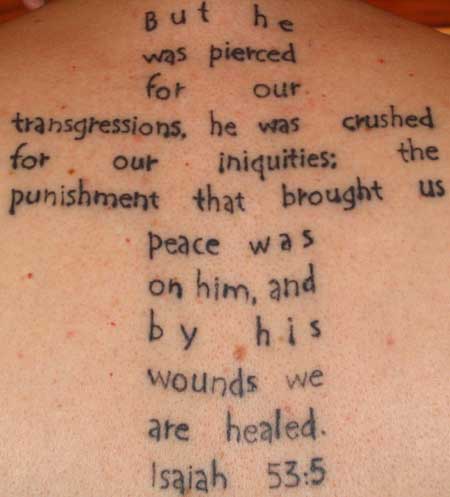 passage without talking about Jesus. For tradition has dictated through the years that Isaiah 53 is indeed directly talking about Jesus. And if you look at the front cover of our bulletin for this morning, you'll notice it's a picture of person's back tattoo with this verse of scripture on it. And it is in the shape of a cross. You don't have to go far until you realize for traditional Christians, Isaiah 53 has become a playbook for Christians seeking to explain atonement-- what Jesus dying on the cross really meant and means.
But, to answer the question placed before us in the sermon for this morning: "The suffering of Jesus means what?" we must be stay with the crucifixion of Jesus more than just one day every year-- if that at all (for in fact, the Good Friday service is one of the most poorly attended worship services globally in fact. . . But that's a whole other sermon). We must learn to stick with the hard questions of faith-- even if they make us squirm in our pews a little bit more this morning. Hard words like "atonement."
If I say the word atonement-- a most basic theological definition of this word is Christ's work of redemption on behalf of humanity.
I want to share with you two camps of atonement theory-- not to just to help your theological education and understanding of the text before us today-- but because so much of how we explain our faith to our neighbors (via evangelism or not) has a lot to do with how we describe atonement. And, it is so much a part of popular rhetoric about Christianity.
Realize this morning for sake of time and our brains not exploding, I'm painting with some broad strokes here. There are indeed more than two camps of atonement theories, but I believe in light of Isaiah 53, these are the two we should most understand. I don't always say this, but feel free to take notes if this helps you follow me.
The first camp of the theories is that of substitutionary atonement or in more basic terms the phrase, "Jesus died for our sins."
It's the camp that says that what Jesus did on the cross was to right many wrongs committed by all humanity. And there is a wide spectrum to this belief of atonement. There are some who believe in substitutionary atonement who say that Jesus had to die as a payment for our sins; Christ suffered for us so that we didn't have to.
And at then at the other end of the spectrum there are those who say that the substitution Jesus made was more because God demanded it. God took the life of Jesus as a payment for our sins.
But in either case, the phrase, "Jesus died for our sins" boils down to our being asked to simply believe in Jesus as Savior so that the substitution of our unrighteousness for Jesus' righteousness can take place.
This camp is the most popular of the theories of atonement through Christ tradition. Just pick up any hymn book and turn to the "death of Jesus" section and what you will find are statements about how Jesus paid it all, how we've been washed clean in the blood of the lamb or Jesus took our place on the old rugged cross.
But problems with this theory arise when you take a step back and see the larger picture of what was going in the suffering of Jesus from this perspective. The largest problem is that if you say, "Jesus died for my sins" then you also profess that God set up the crucifixion of Jesus. God brought suffering on Jesus.
Or as Phyllis Tickle once said, "It's a huge example of divine child abuse." And for many of us stomaching following a God like this is too much to bear. In fact, Sojourners magazine just this week, published an article about how seeking to convert someone by starting the conversation with "Jesus died for your sins"[i] can be the scariest thing you could say-- and should be avoided.
However, there is another camp of the atonement theories and this is the representory or exemplar perspective.
In this camp, Jesus was sent to earth to represent God to us. We who were living in sin, we who had fallen short of God's best for us, we who had gone off course of God's original intentions for humanity, were given Jesus so that through him, we could find our way back home to the right path. Jesus showed us a different way to God-- a perfect way.
However, as this theory goes, Jesus did such a great job of showing us God that those with power in his world during his time did not like him. They didn't like him so much that they had him killed.
Therefore, this leads us to recognize that if we follow Jesus and the path he set out for us to know God better, we should not be surprised if we are killed too. For in fact didn't Jesus say to his followers, "whoever loses his life will find it?"
It's a theory in the end that takes the focus off Jesus as the recipient of divine punishment and instead directs us to the cost of discipleship. If we want to follow Jesus, this theory says, then, we must be prepared to suffer.
And it is here at this point that we arrive again at a great point to sit with our Isaiah passage yet again. A passage which speaks of a servant (though undefined who) which suffers. We read of a servant who in verse three "was despised and rejected by others; a man of suffering and acquainted with infirmity . . . has borne our infirmities and carried our diseases."
It's not a type of suffering that we read is just in vain. It's not a suffering just for suffering's sake-- because the Divine is mean and trying to bully his subjects into submission. Rather, it is suffering that makes a difference because God is revealed in it.
For as the servant forged a new path of righteousness and integrity, even in the face of evil, the onlookers of the person going through the suffering saw God.
The onlookers saw God's grace.
The onlookers saw God's message to the world that even though we've all messed up, we've all made some not so good choices in our lives, the Divine says back to us, "You are ok. And I love you."
When I think back to those days of seeking to convert the children on the playground in South Dakota (with some shame of course of my misguided approach), what I most wish I could go back and tell Ana, my young friend with mad skills on the monkey bars is: get to know Jesus.
Get to know this man who loved you even before you were able to love him. Get to know this man who wanted you to know your heavenly parents-- your always loving parents, always forgiving, always providing parents more than anything, so badly that he gave up everything so that you could have this chance.
And come and learn of Jesus' suffering too-- how he was rejected for doing the right thing. For you, Ana will suffer much in your life (if you haven't already), and you'll need to know that someone has been there too. Jesus suffered to the point of death so that in his life, he could show us the way to God. And the God you'd learn more about through Jesus is the God who loves you already more than you could ever imagine!
Because atonement theories or not, isn't this what all of us long to hear? That we are loved. That God sees us, especially in our moments of deep pain.
That Jesus not only offered us through his life (which included suffering) a way to be in deep relationship with God.
And that as we suffer in this life, our pain, as we give it back to God for God to use for divine purposes in this world can be redemptive too?
AMEN
[i] http://sojo.net/blogs/2012/07/06/ten-cliches-christians-should-never-use#.T_drmq6o9g8.facebook
Promise in Night: Endurance to Stand
Mark 15:1-20 with Isaiah 50:4-9
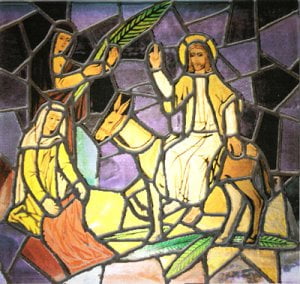 As we began our service today outside, we re-enacted together what it might have felt like to be among the crowd waving palm branches and singing the praises of "Hosanna!" We shouted praises of thanksgiving for Jesus. We hailed Jesus as king. We adored his name.
But, as we know and as we continue to follow the story from Mark's gospel, the shouts of praise for Jesus were not the whole story. Jesus' darkness would soon be upon him. Soon Jesus' courage, determination and ultimately proclamation of his Lordship would bring about his sentencing.
This is what we need to know: Jesus enters Jerusalem for the Passover fully intent on continuing the mission that was set before him at the beginning of his ministry: “bringing good news to the poor and release for the captives and proclaiming the year of the Lord’s favor.” Nothing was going to change about his message of this "upside down kingdom" of the first being last and the last being first on the last week . . . no matter what kind of outside pressure Jesus got to back down.
But, as we know, none of this was really acceptable in the eyes of those who were hanging their hat on getting something really good at the end of this adventure of following Jesus. We know the disciples scattered and denied knowing him.
Judas, the money keeper, led the high priests to send guards to arrest him. Peter trailed behind and say, "I do not know this man."
And, Jesus certainly wasn’t winning him any support in the crowds either as the accusations were brought up-- no one wanted to say that they knew or loved him. And though the high priests found fault with him, they had no power to sentence him to die. We see in verse 1 of chapter 15 of Mark's gospel that the elders, teachers of the law, and the whole Sanhedrin reached a decision, "They bound Jesus and led him way and handed him over to Pilate."
In the Roman Empire the justice system made no provisions for a trial by jury. It was up to the ruler in charge to decide how he would judge cases. Therefore, after conferring with the religious leaders who brought the charges against Jesus, Pilate, the Roman administrative official, proposed to flog Jesus for his unlawful teaching and release him. But he looked to the crowds for moral support. Not acting as Pilate expected, the crowds strongly disagreed with anything other than the ultimate punishment under Roman law. As defiantly as Pilate said Jesus does not deserve death, the crowds demand for Barabbas’ (a convicted criminal) release and shout loudly: “Crucify Him! Crucify Him!”
Let's stay here at these words: "Crucify Him! Crucify Him!" and notice how quickly the crowds who said "Hosanna" changed their tune. We find that spiritual maturity was at an all time low in the land. Although Jesus healed the sick, helped the lame, and blessed the children, it didn't matter. It was if they just completely forgot the belovedness of their teacher-- and were caught up in the emotions of the moment. With ease, they said with their words, "Jesus, we want you gone!" It was the dark night of soul-- betrayal at a corporate level! It was a moment when the suffering for Jesus went to an even deeper level.
So, what was Jesus' promise in the night now?
If you've stuck with me throughout Lent, you begin thinking that in the face of the horridness of crucifixion to come, there possibly couldn't be a promise for Jesus at this juncture! We must have run out of promises by now!
But, such is not the case when we peer into our Old Testament lesson for this morning from the book of Isaiah. As the children of Israel continued to deal with the ongoing disappointments, frustrations and shouts of "How long O Lord?" are you going to make us wait in Babylon in exile, hope seemed lost. They basically were shouting "We want to go home!"
Verse 6 of Isaiah 50 serves as the center piece of the Israel narrative telling us from a personal perspective what it feels like to be in the midst of a time of deep loss and pain. And though the desire to give in, give up, or simple fall under pressure arises, Israel is asked to be strong. Israel is asked to actively wait. Israel is asked to stand and move through their sufferings through resistance that is not self-seeking, but resistance that sees the bigger picture.
Verse six says, with a collective voice for Israel speaking: "I have my back to those who struck me, and my cheeks to those who pulled out the beard; I did not hide my face from insult and spitting."
With some consideration in mind for the trials of the life of Israel at this time, it seems odd doesn't it that they'd be boasting of "turning the other cheek?" We might even call this weakness. But, courage comes it seems to remain in this posture, why? Because look with me at verse 7: "The LORD God helps me; therefore I have not been disgraced; therefore I have set my face like flint, and I know that I shall not be put to shame."
In a nutshell, Israel remains committed to enduring the injustice in an active way-- for the only way to faithfulness is to move their way through the suffering is to simply keep standing. Why? We hear the testimony of the Lord being with them.
If we go back to our gospel for this morning, we see this promise lived out in Jesus as he stays grounded in himself-- no matter who spoke ill against him. For there was no amount of shouting, no amount of mockery, no amount of physical pain would change him or set him off course of fulfilling his mission. With Jesus:
There would be no overt shows of power for power’s sake.
There would be no reigning down the heavenly lights to slay the captors which spoke ill of him.
There would be no dueling or "I'm better than you" contests between Jesus and his adversaries.
Jesus remained steadfast in suffering.
Do you really get this part of the story? I mean, I know I'm talking to several folks who have been in church their entire lives, but do you really get the point that Jesus could have done anything to save himself, to defend his honor to command his disciples to get their butts out of hiding and come protect him-- yet he doesn't?
If we were to sum up the actions of Jesus during this dark night of the soul, we'd have to say that he modeled for a God-fearing response to suffering as he clung to the promise of "Endurance to Stand."
No matter what. No matter why. No matter how long. Jesus stands. Jesus faces his sufferings head on.
When we think about our own experiences, it is true, like Jesus, we all know a thing or two about situations that are unfair.
Anyone experience a back-stabbing loss lately?
Anyone experience a life-threatening illness lately?
Anyone experience the lonely nights of grief lately? I see many faces nodding back at me in affirmation.
But, while true, as we were discussing in our Wednesday night grief class recently, few of us (if any) have faced suffering to the decree that it threatened to end our life as Jesus did in this reading of our scripture this morning. Few (if any) of us have been asked to make the choice of either our faith or our life again, as Jesus experienced. But, such has not be the case of all Christ followers throughout the centuries.
Consider the Civil Rights movement in our country over the last century and the suffering evoked for many as a result. It was a time in our history when making stands for racial equality in the name of one's faith, easily could have cost you your life.
Under the leadership of Dr. Martin Luther King, especially, hundreds, then thousands, then ten thousands, of folks took stands for freedom for all, putting their own lives in danger. But they did so not the way that their adversaries expected. No militia formed. No battle plan of warfare was drawn. No slogans of "We really hate you, oppressive white folks" were placed on protest posters. No, a revolutionary campaign of non-violent resistance began through boycotts, marches and speeches. But, not without some push back from community leaders who thought this approach of standing tall and not backing down to fear or to violence was pointless. Dr. King had some explaining to do. During the Montgomery Bus Boycott in 1957, Dr. King sought to give theological perspective to simply standing strong saying:
A nonviolent resister does not seek to humiliate or defeat the opponent but to win his friendship and understanding. This was always a cry that we had to set before people that our aim is not to defeat the white community, not to humiliate the white community, but to win the friendship of all of the persons who had perpetrated this system in the past.[i]
And, yes, as we know from history, there was suffering to the non-violent protests for civil rights. That while yes, friendships across racial lines were formed and while, human dignity was restored to many, it wasn't the whole story. Martin Luther King, Jr. and friends spent nights in jail. Dogs and fire hoses were directed toward school children. It led to the senseless death of four little girls in Sunday School class in Birmingham. And the list could go on. Suffering came. And it wasn't pretty. We know Dr. King eventually lost his life in the fight.
Teresa of Ávila, the sixteenth century mystical writer, knew of this wrestling with life-threatening suffering.
In a particularly difficult moment of her life she was forced to cross a river while sick with fever. She raised her voice of complaint heavenward, "Lord, amid so many ills this comes on top of all the rest!" A voiced responded, "This is how I treat my friends." "Ah, my God!" Teresa retorted, "That is why you have so few of them!"[ii]
In the same way, when we too continue to grow in our faith and walk in the footsteps of our Lord, I believe, much like Jesus, and like our forefathers and foremothers in the faith, we too will face suffering that it must to our distaste. Our suffering too will be longer. It will be more painful. It will cost us more than we ever could have imagined. It will force us to rooms filled with darkness that we'd rather overlook than deal with head on. But, as friends of God-- it doesn't matter, suffering is just a part of the human condition, even as Jesus lived it.
But, as followers of Jesus, as we suffer, is does not come without comfort. We are given the courage to actively say "no" to what is unjust even if pain still comes. We are not asked to lose our souls in the process. We are given endurance by our Lord to stand through it and to know that even if death comes, resurrection is on its way.
Look with me again at verse 8 of Isaiah 50. The prophet speaks of the shared communion in sufferings as he writes, "Who will contend with me? Let us stand up together. Who are my adversaries? Let them confront me. It is the Lord God who helps me."
Let us stand up together-- the Lord says!
When insults are thrown against us, we can say because of the Lord, "I'm going to stand!"
When gossip is hurled against us, we can say because of the Lord, "I'm going to stand!"
When our best friends reject us and leave us alone, we can say because of the Lord, "I'm going to stand!"
When our words of testimony at work about our faith cause others to mock us, we can say because of the Lord, "I am going to stand!"
Some may feel it is in the fine print of the Christian contract (all this business about suffering), but following Jesus is anything but safe, I must remind you! The prophecy of Isaiah puts a sharp question to its readers, "Will you identify yourself with the suffering One?"
Jesus stood and now today invites us to stand too.
Today, I ask you, will you follow this Jesus? Will you commit to stand with him even if the night is long? Will you commit this week in a practical to go with him to the cross-- all the way-- even if it means taking time off of work, leaving some home chores undone or even changing some travel plans so that you can attend our Maundy Thursday and Good Friday services coming up this week?
The blessedness of our promise for this morning is that as much as we are willing to stand with Jesus, Jesus is willing to also stand with us.
So, today, let us come to this table together and share of the meal that reminds us that we are not alone, we worship the one who says to us, no matter what trials find our way, that we are not without grace to keep going. Our suffering is not useless. For, we are standing together with our Lord. Therefore, no matter what may come, no matter what may go we have this promise in our night: Jesus says to us, "I'm giving you endurance to stand with me."
AMEN
[ii] Illustration found in Working Preacher: Sunday of Passion "Isaiah 50:4-9" Mark S. Gignilliat http://www.workingpreacher.org/preaching.aspx?lect_date=4/1/2012&tab=1
 "Everything happens for a reason" such are words that we, as pastoral care givers are often tempted to use though they are not in the Bible anywhere.
We deal with so much crisis. We get tired of saying profound things. We want to feel good about the care we are giving, knowing that our care is making a difference. We want to give people hope that their suffering is not in vain, that it will amount to something greater in the end. We want to be an expert with something to offer the pain of those in whom we are called to care about.
But the truth is we are not God. Sometimes there are no answers. And trying to give a plastic answer often makes it worse. (Read the book of Job lately?)
When I hear the words "everything happens for a reason," it's like scraping the chalkboard of my soul. For, as much as I am tempted to say such as a way to easily explain away life's pains for myself and others as a pastor myself, I simply can't say (or even hear) these words.
For everything doesn't happen for a reason. Sometimes life just sucks in this sin sick filled world we live in. And often it is not our fault. It just is.
I grew up in a tradition of faith that taught when bad things happened in your life it was the result of either a) a major personal screw up b) being out of touch with a close relationship with God via doing things like regular Bible reading, church attendance and tithing regularly. I was taught about a "if/ then God." If I do what God wants, then God will bless me.
I truly bought in to this way of thinking as a child, believing that if something was going wrong in my life, it was somehow my fault. God must be punishing me or trying to teach me a lesson. I remember the day my youth group leader told us that you could tell who was living right by who God was blessing with good grades, winning sport games at school, and happily finding mates after completing their "true love waits" pledge to remain sexually pure until marriage. What lies. And it got worse . . . we were told that those who faced difficult life circumstances such as death of family member, the coming of an earthquake or fire, or whose marriages fell apart usually resulted from sin. The reason for these horrible things happening was God saying: "Clean up your act."
Maybe for those of us who are leaders in giving care to others, we can find ways not to either explain away life's troubles with "it will all be good in the end" or "it is somehow your fault" instead to simply be with those in pain. Sure, there might be something beautiful that comes out of life's most tragic moments, but it doesn't take away the gut-wrenching grief of the process.
For I believe it is not important to figure out the why's of suffering-- life is simply too complex and mysterious such answers-- rather to simple be present in life's moments whatever they may be. Knowing that as we stay close to whatever emotions we are feeling, whatever is troubling our souls, there will be a path of peace to lead us to quieter waters someway somehow.
Let us stop, my caregiver friends, making this pastoral fail. I wrote this blog for this reason.
