A sermon preached at North Chevy Chase Christian Church in conversation with James 1:17-27
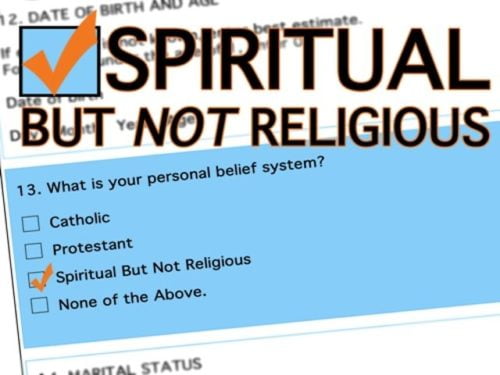 "I'm Spiritual but not Religious" is among the most commonly cited reason why people don’t come to church. Over the years, I've heard:
“Pastor, I don’t think I need to come to church. I’d rather commute with God by watching the birds on Sunday. This is my spirituality.”
“Pastor, I don’t think I’m coming to come to church anymore. It’s nothing against you or the church people. You all are nice and all. I just don’t need a church for my faith.”
“Pastor, I just don’t know how you can stand working for the church. Have you read history books? Have you read the news lately? The church hurts people. I just don’t get how you could be in the ‘religion’ business.”
But, today, I’m musing about this statement, “I’m spiritual but not religious” in hopes of opening up a larger conversation because I've grown weary of the debate.
I want to start by saying that I believe "spiritual but not religious folks," are good people too. They aren't all anti-Jesus. Their lives aren’t completely void of faith practice. In fact, their lives are often full of good and God fearing things. Many seriously pray, read, meditate, etc. with great furor and discipline our scriptures.
So I don’t necessarily think the excuse of “I’m Spiritual but not Religious” is about laziness—but in many cases their devotion to God puts those of us who are “religious” to shame.
But, even with this true—we in the church often feel like our "spiritual but not religious" friends are like the distant step child that we’d just wish would get with the program, stop being so independent and critical of our structures and join our membership rolls.
We often feel tempted to criticize their faith, especially as their attitude of “My faith can survive without your unnecessary institution” seems like a big slap in the face, to what we’ve worked so hard to hold together all of these years.
We feel tempted to talk about their egos without even considering our own.
And even worse, our culture seems to be in their side with the assumption that spirituality is good; religion is bad.
Or, spirituality equals pure faith and God’s presence. Religion equals corruption, human made flawed structures. We find religion in churches. We find God in spirituality.
Yet the book of James has a lot to offer us here.
And while it’s a book that Martin Luther was known to say is the “epistle of straw” saying that its practical approach to faith is not theological enough—I believe that James is an amazing ancient text wrestling what might not be truly modern problem after all.
James wrote to a community of believers concerned about the essence of faith.
In James' time were many who said: “We’d better get our theology in order. We need to write more doctrine.”
And there were others who said, “Theology is well and good, but what does it mean? What does it look like?”
And to these questions James re-directs the conversation back to God. If I were to sum up the entire book for you it would be this: "It's not that I want to throw out all the great work that Apostle Paul has done in other letters helping us to define the essence of faith. But, I do want you to know how to LIVE OUT YOUR FAITH."
For you can talk a good game for a long as you want, have all the right answers with what you think Jesus meant about this and that, but if your life doesn’t SHOW what you believe then it’s all rubbish.
Pure rubbish.
He writes in chapter 1 verses 26-27: “If any think they are religious, and do not bridle their tongues but deceive their hearts, their religion is worthless. Religion that is pure and undefiled before God, the Father, is this: to care for orphans and widows in their distress, and to keep oneself unstained by the world.”
James is saying that religion’s sake is worthless. It’s a simple but profound truth.
For, if we keep up tradition, for tradition’s sake, it’s worthless.
If we conduct church business in a particular way because it how they did it back in 1995, it’s worthless.
If we maintain our buildings for the sake of maintaining our buildings, then it’s worthless.
If we do a program in the church simply because it went over well last year, it could be worthless too.
For James wants us to consider WHY we do what we DO. For going through the motions is not faith. It’s religion.
In my work with churches during interim times, I’m often pushing church leaders to wrestle with questions like this (and sometimes making people mad in the process):
“Why do we always to have all of these standing committees? Why do we keep these bylaws around though they were written for a church 3x our size?”
“Why do we keep on programs that no one attends?”
“Why do we only welcome people who look like us? Why do we not push outside our comfort zones?”
I ask questions to push congregations to consider how well-meaning structures and activities have become “going through the motion activities” instead of active faith . . . the kind of faith where we are living out the gospel: good news for all who hurting the most.
Let me stop here and say that I’m not saying structures are bad. Rather, mindless choices we make in the name of religious tradition never up for reconsideration are. For sometimes traditions and religious teaching and practice can be indeed just this—practice from human hands, flawed and in need of a fresh wind of the Spirit upon it over time.
Because don’t we believe that Spirit is always at work in our world? Don't we believe that God can always do a new thing?
And if this is true, then what God wanted from us and what we spent so much time building in 1980 might not be what God wants from us in 2016, right?
When it all boils down to it—I believe James begs the church of his day and the church of our day to ask ourselves—are you spinning your wheels on building up what matters or are you just spinning your wheels?
Is our religion that of caring for orphans and widows i.e. those in need of compassionate justice in this world, the most vulnerable?
Or is our religion that of building bigger buildings and structures that leave a mark of “we were once here?”
For, if our life together in community falls more in the second camp then, James tells us to re-think our religion.
Anytime I do a funeral service, I find myself repeating a phrase of exhortation to the mourners—a phrase, I hope at least some of them might remember later because it asks them to channel the grief and loss in life well lived in the here and now. I guess I should get some new material but I can’t seem to find a better way to say it.
“When you and I die, only one thing matters: not how much money we have, not how many flowers decorate the alter, not how many people attend, not how many groups or societies we belonged to—only one thing—is it well with our souls? Are our lives in harmony with God? What will profit a man or woman if he or she gains the whole world and loses their own soul?”
To me this is the important stuff of life: is it well with our souls?
So, this brings me to the place where I really want to say to those people who tell them they are too spiritual for church—I understand. I hear your frustrations.
I realize the church can be a messed up place where we don’t talk enough about how things are with our souls. Institutions are like this. Sometimes we make good decisions that bring us together and other times we miss the mark painfully by spending TOO much time organizing ourselves.
But, I also believe the church is where God wants to teach us. Is the church perfect? No. Has it made way more mistakes in its formation, declarations, and judgments than it has for the good of the world? Probably.
Yet, I won’t leave the church, though; it might be a lot easier in the short turn with a lot less meetings (I mean A LOT less meetings!)
Why? My faith is communal. It’s communal with the saints and sinners who have gone before me. I believe the Christian journey,  like that of the Jewish journey or the Muslim journey, is one at requires a lot more “we” than “I.” I need the church’s religion for my spirituality to have a home.
So as you read this my friends, may we not just be those who listen to the word, but are those who DO what it says. This means putting away the excuse or the debate of spiritual vs. religious and getting to work.
Getting to work to bless the homeless.
Getting to work to bless the lonely.
Getting to work to bless the dying.
Getting to work to bless the children.
Getting to work to bless the stranger.
Let us get to work! Let us put away the excuses. And let us live out our faith as the Spirit leads us.
Knowing that no mater if our church building are ever full again-- the calling still remains. Are we listening to the Spirit? Is it well with our souls? Are we blessing who need a blessing the most?
This is our faith. Let's get to work.
 As I'm getting back in the swing of the more structured pastoral life again, I am beginning to engage in conversations with folks that sound a lot like this:
"How do I know God's will for my life?" or "How can I know what God wants me to do?"
When I get asked questions like this, I usually feel inadequate (not because I didn't go to seminary or take lots of pastoral care classes) but because it is as if the questioner is asking me to play the role of God in their life, telling them what they are to do as they face difficult decisions.
At heart, I see the role of a pastor to be that like a spiritual director, an intentional relationship between a people and one called out to lead of figuring out what it means to find the presence of God in community. And so, as a pastor I still serve in the role of learner as much as I do a teacher. Thus, for me to give a specific answer to "This is what God wants from you" with complete authority can often be off base and misstated. One of my favorite prayers from Thomas Merton speaks of the fact that as much as we think we are doing God's will, we may not be.
So, if even pastor types can not speak definitively for God with absolute certainty, then how can we know? How can we discern God's steps for us when we reach junctures of big decisions?
I would have once answered this question by saying large amounts of time need to be offered up to God sitting quietly in the woods or taking residence in prayer closets. I would have said that if you diligently search the scriptures, an answer from the pages would come. Or, I would have said that if the decision leads to more folks coming to know of Christ, then of course it was the right one (can you tell I used to be an evangelical?).
But, as I've grown in faith, I've come to see a way of discernment that doesn't always have to include words shouted from the heavens with my name in them or having moments of great epiphany in prayer. It's actually much more messy than this. Sometimes as much as we think we know, we don't. My spiritual director always says meaning is revealed (to which I find frustrating of course).
So from my own experience (which again is just my own experience) this is what I know:
Sometimes, actually often times, discernment for me now looks like the simple practice of putting one step in front of another and seeing what comes. Knowing that as I go down a path, the Spirit can be trusted to show me where I am to be and where red flags are shouting "stay away, go the other direction."
Sometimes discernment comes in a word of a friend that I can't seem to get out of my mind.
Sometimes discernment comes as intuition that I believe from my heart that can't be shaken, no matter what occurs.
Sometimes discernment comes as pieces of a life direction falling together in ways that I know I could never dream up or orchestrate on my own even if I tried.
Though I am often not much help to those who come to me seeking "the answer" to their troubles, hopefully what I can do as a pastor, as a friend, as a wife is to listen, to say what I hear and hope for the Spirit to make clear what needs to rise up and what needs to fall away.
Because after all, this is what doing life together is at its best. For as much as I can be this for fellow travelers on the journey, I need the same folks to do this for me too.
Discernment then looks like me walking alongside you, you walking alongside me with open eyes, attentive feet and ears to hear "This is the way, walk in it."
Kevin and I recently returned from a short visit to South Georgia where all of his family lives but us. One of the joys of every visit we make down to Georgia is time that we get to spend with our four young nephews. It’s always fun to spoil them and then get to leave when they start fighting . . .
 I always find myself playing with of my nephews, Landon, age 9 who seems to latch onto me from the moment I walk in the door till the moment we leave. When I can get him off my IPad (where he’s proceeded to load every new video game imaginable) we play board games.
One of the games that we often play together on the floor of my in-law’s living room in Rummikub. Success at Rummikub depends on good draws of chips and insightful strategy of matching rows of numbers and colors.
But, if you draw the smiley face—you find yourself with the game-changing tile! I love watching the glee that comes across Landon’s face when he draws it. For I know in that moment he thinks he’s hot stuff!
For with the smiley face, you can play almost anything and get rid of the numbers on your tray faster.
Much like in other games, the smiley could be called the ultimate trump chip or trump card because when you have it in your line-up, the rules no longer matter anymore. You can really do whatever you want!
In the same way, Matthew 18:15-20 seems to present us the ultimate trump card when it comes to life in Christian community.
And in sum it says this: if someone in the church sins against you, go and talk to them in private. If they won’t listen to you, take 2 or 3 more people. Then if the “sinner” refuses to listen to you then, tell the church. If they don’t listen to the church then let them go on their way without blessing.
Or in other words, my Bible verse trumps you.
You don’t have to do a very exhaustive search on the Internet to find Christian ministries who have framed their governing boards around what many of them call the “Matthew 18” principle.
Everyone from the Association of Christian Schools International to Focus on the Family to Lifeway cite Matthew 18 as the formula by which to handle conflict in the church.
But, the Bible as I come to understand it never gives us a checklist. As Jesus is teaching, it is always about a conversation into what life in the kingdom of God entails. And it is always more complicated than it seems at face value.
Consider this. A Methodist pastor friend of mine in Virginia once told me the story what happened at his church after a long tenure in a particular community. He had become particularly passionate about connecting his congregation with a church in Rwanda.
The Rwandan church was located in a community where hundreds of families were out of reach from life’s most important essentials, especially water. After several exchange trips where members of the Virginian church went to Rwanda to visit and the pastor of the Rwandan church came to America, it was decided that the Virginia church would help bring fresh water to the community.
It would be a large chunk of the church’s budge to fund such a sustainable project—literally nowhere near a major city so they pipelines would be long. But the pastor knew it was the right thing to do. And the Rwandan church couldn’t have been more grateful. Even though one church leader met with him once to explain her concerns otherwise the pastor thought overall the church leadership was behind him.
This was until the deacons from the church board appeared at his house one night. They brought their Bibles and said that they needed a word with him. After settling in into the pastor’s basement living area they read part of our scripture passage from this morning. They told him what they really thought of the Rwandan project.
“It’s our Christian duty to tell you that you’ve sinned. Building that well is a waste of our resources. You should be caring first about the community in the local area first, not the Africans.”
Furthermore (they went on) if the pastor wanted to continue at their church, all contact with the Rwandan church must stop immediately.
But I’m sure you can imagine that this pastor was devastated. Maybe he’s misjudged the pulse of the church and led with a lot of gusto but such did not warrant the “visitors in the night” intrusion as he would later call this incident.
In the end, the church did stop its ministry in Rwanda (sigh) but the pastor (I guess luckily) didn’t loose his job over it.
But what bothered him the most was how the deacons used scripture. It was as if this Matthew 18 passage was the trump card to get the pastor to do what the deacons wanted him to do.
A story like this one is not an isolated example. I know dozens of churches wrecked by conflict that goes back to the same sort of thing. It’s the stuff of the worst of church life is made of.
Our pattern becomes we take scripture. We present it from the perspective of “you’re a sinner” and “I, the real Christian” knows best. And then we use scripture to hurt people. We really hurt people.
This is not to say that discipline isn’t important or sin isn’t really or talking to those in whom we have conflict one-on-one isn’t a good idea. BUT, how we use our so-called trump card of power in numbers has to be handled oh so carefully (if at all).
But it is important to consider that the lection ends this way: “For where two or three are gathered in my name, I am there with them.”
To help myself get the point I wrote it out like this:
If another member of the church sins against you, go and point out the fault when the two of you are alone remembering that I, Jesus, am there with you.
But then if you are not listened to, take one or two others along with you, so that every word may be confirmed by the evidence of two or three witnesses, remembering that I, Jesus am there with you.
If the member refuses to listen to them, tell it to the church; and if the offender refuses to listen even to the church . . . remember that I, Jesus am there with you
As simple as the addition is, it sounds different doesn’t it?
And this is what Holy Spirit abiding with us, and blowing through us, and giving life to the church in the first place is all about.
We are never alone. We are never abandoned. God the Father, the Son and the Holy Spirit is with us.
And because of this WE CAN CONNECT to those most impossible people that we don’t understand or appreciate. So, we don’t have to waste so much of our time labeling particular people as "sinners." But, we let the Spirit of God do the work of joining our hearts.
Thanks be to God that the one who holds the “trump card” is not us-- but the great mystery of the Spirit, always at work.
 This weekend on Friday night and Sunday morning while gathered around the tables after sharing a meal together, Washington Plaza Baptist engaged in a study of spiritual gifts based out of Romans 12:1-8.
Why did we do this?
Learning about and discussing spiritual gifts seemed like a great fit for these two goals.
How thankful I was to Beth Dotson, a friend and former teacher of mine to come and lead the special weekend events all the way from Tennessee! Her presence was a blessing to all of us.
If you missed the action this weekend or just want to know more about this motive gift study that we've been up to, here's the summary. You can also take a test online by clicking here. Feel free to email me if you want more information. (Pastors and other church leaders: I highly recommend this study!)
MOTIVE GIFTS: Romans 12:1-8
Each motive gift (basic God-given inward drive, motivation or inclination) and may be symbolized by a figure to help focus its nature.
1. Prophecy: An eye. Declaring truth and insight with the aim of evoking repentance and restoration. The ability to “see”, to discern, where people or programs really are. The motivation to make motives right. TRUTH.
2. Serving: A hand. Giving practical assistance and help. The ability to both see and do things which need to be done. The motivation to demonstrate love by meeting practical needs and giving assistance. ACTION.
3. Teaching: An ear. Clarifying truth. Primary emphasis on the Word. The ability to impart knowledge and to lead others into revealed truth. The motivation to search out and validate truth which has been declared. CONSISTENCY, COMPETENCY, AND THOROUGHNESS.
4. Exhortation: A tree. Stimulating spiritual growth; lovers of people. The ability to encourage people to grow and to successfully meet the experiences of life. The motivation to stimulate the faith and personal maturation of others. GROWTH.
5. Giving: A gift. Giving and motivating others to give. Special sharing of material assistance. The ability to handle and give assets. The motivation to see the work of God and the ministry of others go forward and succeed. STEWARDSHIP.
6. Leadership: Profile of a face. Organizing people to complete a goal, giving administrative and leadership aid. The ability to see long-range goals and to facilitate others in the right tasks. The motivation to coordinate the activities of others to achieve common goals. TASKS AND RESULTS.
7. Mercy: A heart. Personal support, empathy, with primary compassion for spiritual and emotional rather than practical needs. The ability to feel where people are and to identify with and relieve those who are is distress. LOVE.
GIFT
|
DEFINITION
|
NEEDS MET |
WHAT IT DOES
|
PERCEIVER (PROPHET)
|
Declares the will of God |
Spiritual |
Keeps us centered on spiritual principle |
SERVER |
Renders practical service
|
Practical |
Keeps the work of ministry moving
|
TEACHER
|
Researches and teaches the Bible |
Mental |
Keeps us studying and learning God’s Truth
|
EXHORTER
|
Encourages personal progress |
Psychological |
Keeps us applying spiritual truths
|
GIVER
|
Shares material assistance |
Material |
Keeps specific needs provided for
|
ADMINISTRATOR
|
Gives leadership and direction |
Functional |
Keeps us organized and increases our vision
|
PERSON OF COMPASSION (MERCY) |
Provides personal and emotional support |
Emotional |
Keeps us in right attitude and relationships
|
 "What brings you deep joy?"
"What stirs up in your happiness that is long-lasting?"
"How do you feel God has gifted you for service in the Body of Christ?"
Such have been questions our adult Sunday morning class has been considering over the past two Sundays in our "Congratulations, You Are Gifted!" class. January in worship and in all aspects of church life is focused this year on calling and spiritual gifts. We're even having a special community gathering on Friday night (and Chili Cook off too) to talk over all of this in an informal setting. We're claiming that the life of discipleship is all about first knowing ourselves and in the authenticity of God's gifts to us serving others accordingly. Biblical texts such as I Corinthians 12-14 and Romans 12:1-10 have been keys to this study.
Yet, what I have found in teaching is many folks really don't know what brings them deep joy and some have never studied spiritual gifts before. So, we've been starting with the basics. Beginning with detecting clues about what makes each of us tick, what moves us and what our aspirations for our future might be.
We began the discussion Sunday with everyone sharing their answers to some fill in the blank questions. One of these was: "Movies, songs, books, art, experiences that have touched me the most are…"
Though I didn't answer it in class, if I did, I would go to first to the song, "Say" sung by John Mayer. It is a ballad I sometimes listen to on Sunday mornings in effort to gear myself for preaching. It is good not to be afraid to say what I need to say. It is good to be filled with confidence that no matter what God will find a way to speak through me. I'm sure Mayer was not thinking of the preaching task when he recorded this, but for me, he is:
Take out of your wasted honor
Every little past frustration
Take all your so-called problems,
Better put them in quotationsSay what you need to say [x8]
Walking like a one man army
Fighting with the shadows in your head
Living up the same old moment
Knowing you'd be better off instead,
If you could only . . .Say what you need to say [x8]
Have no fear for giving in Have no fear for giving over
You'd better know that in the end
Its better to say too much
Than never to say what you need to say againEven if your hands are shaking
And your faith is broken
Even as the eyes are closing
Do it with a heart wide openSay what you need to say [x24]
I look forward to what the next two sessions of our "Congratulations, You Are Gifted" class will offer all of us. My hope is that all of us find a way to "Say what we need to say" about our own lives and begin to live into our calling and spiritual gifts as a community.
American Christianity deeply troubles me.
It's not because average attendance in mainline denominations is dwindling more and more by the year.
It's not because more and more folks are self-describing themselves "spiritual but not religious."
It's not because some sociologists are saying that the influence and prominence of religion in American public life is also declining.
(Not that these things aren't worrisome and in need of smart, creative voices of hope to guide us, like this one to what is next).
 Rather, it is how we as Christians across the theological spectrum relate to one another. It's no secret that Christians are often the most unkind to one another. It is as if our community life is not framed over the love commandment and to do unto others as we would want done to us.
But, what bugs me even more than this is the unofficial practice of religious litmus testing of theology, determining whether or not we "approve" or "validate" or claim the others' faith as real. And, if the others' faith is not "real" according to our standards then refusing to engage them.
It comes out in the particular questions we ask one another: "What is your church like?" "Or what is your pastor's name?" or "Are you welcoming (i.e. do you like gay people)?"
It comes out in rolling of the eyes and looks away in disgust.
It comes on whether or not you watch Fox news or MSNBS and refer to it regularly in conversations.
It comes in the application questions for scholarships, employment and funding from Christian organizations. Buzz words like "I prayed about" "I accepted Christ as Lord" or even "I feel called" are used to validate the strength of faith.
As our culture grows more and more geared toward sound bites, if something is not done about it, our religious litmus tests for one another will grow to be something we don't even do quietly anymore but openly without shame. Consider how mainline denominations are parting more and more as we speak now on issues related to women in ministry, progressive theology and gay rights. If a church doesn't pass the litmus test, they are often thrown out of a local associations as this Baptist church in North Carolina recently experienced, for example.
There's a song we sing at Washington Plaza every Sunday at the conclusion of services called Make Us One.
Make us one Lord, make us one. Holy Spirit, make us one. Let your love flow. So the world will know we are one in You.
It's a chorus we love around here and my hope for my larger community of faith in the Christian tradition and otherwise-- those who agree with me and those who think I'm a heretic for what I do in being a pastor. After all we're just human beings, ashes to ashes and dust to dust, right? Do we really think we have that much power over the fate of one another in the end? Let's put away the tests.
Like my grandma used to say, when all else fails, "Just be nice."
